KEY TAKEAWAYS
- A completion rate measures delivery, not capability. It tells you content reached someone. It says nothing about whether they could act on it under pressure, which is the only thing the business was buying.
- More information has not produced better performance. Access to material has never been easier and the transfer problem has not moved. The constraint was never supply.
- Experience is not a delivery format. It is a different mechanism. Reading about a decision and making one under consequence lay down different things, which is why one survives the week and the other does not.
- Time to competency is the number worth arguing about. How long before a person does the right thing without prompting. Everything else on a training dashboard is activity.
Every organisation that has bought training in the last decade has bought more of it than the decade before. More modules, better platforms, cleaner interfaces, content available on any device at any hour. By every measure of supply, workplace learning has never been in better shape.
And the complaint has not changed. People finish the training and then do the thing they were always going to do.
That gap is usually treated as an engagement problem, or a content problem, or a manager problem. It is none of those. It is a category error. Information and capability are different outputs, they are produced by different processes, and organisations have spent twenty years optimising the wrong one.
The uncomfortable version is this. The easier the information got to reach, the less anyone needed to hold it, and the less it changed what they did.
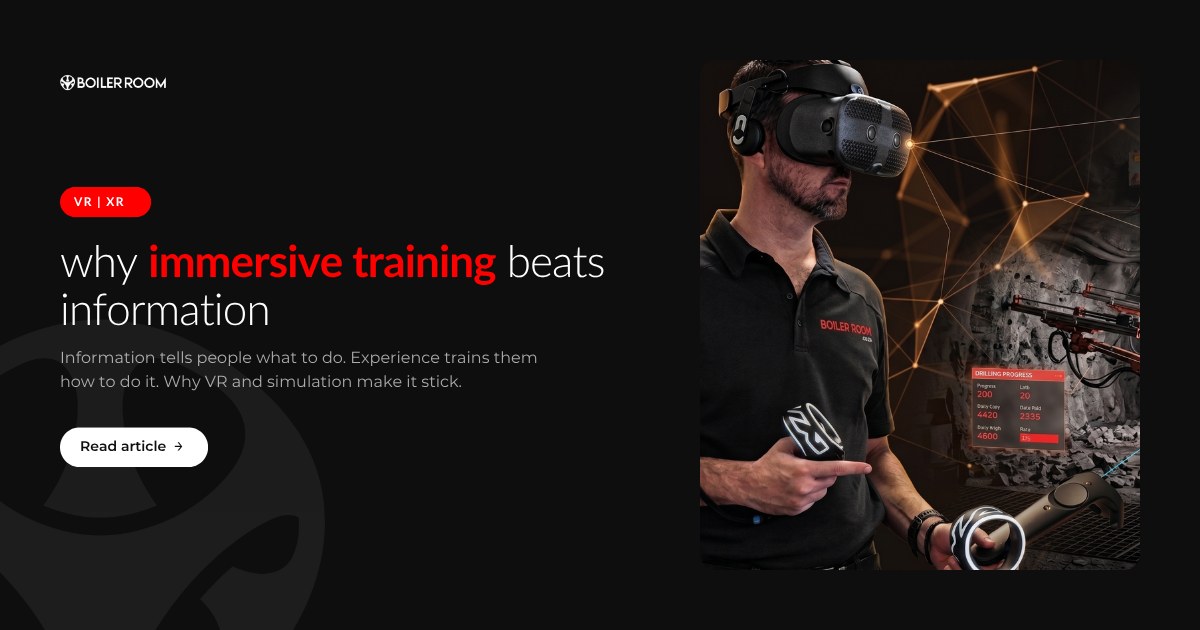
Immersive training places a learner inside a realistic situation where their decisions produce consequences, using simulation, virtual reality, 360 environments or scenario based digital learning. It is not a delivery format for the same material. It is a different mechanism. Traditional training transfers information about a task. Immersive training produces rehearsed behaviour under conditions that resemble the real thing.
Why does more information rarely produce better performance?
Because the bottleneck was never how much people knew. It was what they could do when it counted.
Hermann Ebbinghaus mapped this in the 1880s and it has held up. Most of what a person learns by exposure alone is gone within a day unless something reinforces it, and the shape of that curve was independently replicated in 2015. The finding is not that people are forgetful. It is that information without use decays, quickly and predictably.
Set against that, the scale of what organisations now need to teach is unprecedented. The World Economic Forum’s Future of Jobs Report 2025 found that employers expect 39% of the skills workers need to change by 2030, and that 59% of the global workforce will require training in that window. The line worth reading twice is the next one. 11 in every 100 workers will need training they will not be able to access.
The response to that pressure has been to produce more material faster. Which is a supply answer to a retention problem, and it has not worked anywhere.
What makes experiential learning different from traditional training?
The learner has to make a decision, and the decision has to cost something.
David Kolb’s work on experiential learning set out the mechanism decades ago. Capability forms in a cycle: you do something, you see what happens, you work out why, then you try again differently. Remove the doing and the cycle never starts. A module can carry the explaining step beautifully and still leave the other three untouched.
Sir Ken Robinson spent a career making a related argument about education, that systems built to reward recall produce people who are good at recall, and that capability is a different output requiring different conditions. Corporate training inherited the same architecture and the same blind spot.
Which is where the completion illusion comes from. A completion rate is a real number, honestly reported, and it measures that content was delivered. It has never measured whether anyone can act. The two get conflated because only one of them is easy to count.
South32 underground VR workplace simulator. The learner is inside the situation, and the decision has an outcome.
Does the research support immersive learning?
The mechanism is well evidenced. The vendor statistics mostly are not.
This deserves saying plainly, because our industry has a credibility problem. A great deal of the immersive learning research circulating in sales decks traces back to a small number of single studies, often vendor funded, often five or more years old, quoted as though they were settled science. We do not use those figures and neither should anyone evaluating a supplier.
What is solid is the underlying learning science. Retrieval practice, spacing, feedback under consequence and contextual similarity between training and task are among the most replicated findings in cognitive psychology. Immersive training is not a magic technology. It is a practical way of getting those four conditions into a workplace programme, which is otherwise very hard to do at scale.
So the honest claim is narrower and more useful than the marketing one. Immersive methods do not make people learn faster in some general sense. They make it possible to rehearse a specific decision, repeatedly, in a setting close enough to the real one that the rehearsal transfers.
How does immersive learning solve the attention problem in training?
By making attention a requirement of the task rather than a request from the trainer.
Attention is treated as a discipline problem. It is a design problem. A person watching a module has no reason to attend to any particular moment, because nothing in the next thirty seconds depends on it. A person inside a scenario cannot look away, because the situation moves whether they engage or not.
That is not a motivational trick. It is the difference between a passive and an active task, and it is why the same content produces different outcomes in the two settings.
The measurable version is time to competency. Not attendance, not completion, not satisfaction scores, but how long before a person responds correctly without being prompted. It is the only training number an operations manager can actually use, and it is the one almost nobody reports.
What does immersive learning look like in practice for South African organisations?
It looks like a specific site, a specific hazard, and a specific decision, not a generic library.
South African mining employs roughly 450,000 people directly according to the Minerals Council, with a further 250,000 in contractor roles. The safety picture is improving and still hard. The Minerals Council recorded 41 fatalities in 2025, the lowest annual figure in three decades, with serious injuries down 12% to 1,693. NIOSH reports that more than 40% of the most serious injuries in mining, meaning fatalities and permanent disabilities, involve accidents classified as struck by or caught in machinery and powered haulage equipment.
Those are the conditions the training has to survive. Not a classroom, not a desk, but a haul road at the end of a shift with a vehicle where it should not be.
Boiler Room Productions builds immersive training around that reality. The environments are the client’s own, the scenarios come from their incident history, and the measure of success is what changes on site rather than what was covered in the room. That work runs across simulation, 360 environments and digital induction, and the same argument shows up in mining safety specifically in why mining’s new workforce learns safety differently and the knowledge transfer crisis.
Immersive training built for South African operations, where the environment on screen is the one the workforce actually walks into.
Information was never the scarce resource. The scarce resource is a place to be wrong safely, often enough that being right stops being a decision and becomes a habit.
Is your training measuring delivery or capability?
We build immersive training that changes what people do on site, and we measure it by time to competency rather than completion.
Talk to Boiler Room ProductionsFrequently Asked Questions
Is immersive learning just virtual reality?
No. VR is one tool. Immersive learning also covers simulation, decision based eLearning, digital twins and gamification. The principle is experience over passive content. VR is powerful because it is almost impossible to be a passive observer inside a headset, but it is not the only way to get there, and it is not always the right one for the job.
How long before you see results from immersive training?
Confidence usually lifts straight after training. Behavioural change, things like error rates, safety compliance and procedure consistency, tends to show within 30 to 90 days. Recent research also points to much stronger retention from immersive formats than from passive ones, so the effect lasts rather than fading inside a week.
Can smaller organisations afford immersive learning?
Turn the question around. What is poor retention already costing you? Most organisations have never added up the price of procedures applied inconsistently, training repeated, and incidents that did not need to happen. Once that number is visible, the maths looks very different. Doing nothing is rarely free.
Which industries benefit most from immersive training?
Anywhere a decision carries a real consequence. That includes the obvious high risk sectors, mining, industrial, oil and gas, manufacturing, healthcare and logistics, but it reaches well beyond safety. Boiler Room is currently building a gamified risk module for financial auditors, where the principles of risk and decision making are learned inside a survival scenario and then related back to the audit environment. Wherever judgement under pressure matters, practising beats reading.
Does immersive training replace classroom training entirely?
Not usually. Foundational knowledge still transfers perfectly well in traditional formats. Immersion earns its place where people need practised, reliable behaviour under pressure. The most effective training tends to use both, with immersion handling the part where you actually do the job.
People Also Ask
What is immersive training?
Immersive training replaces passive content with participatory experience. It uses simulation, virtual reality, scenario based eLearning and digital twins so that employees practise tasks rather than only read or watch them. The skill being developed is the skill being practised.
What is the difference between immersive learning and traditional training?
Traditional training delivers information. Immersive learning builds capability through practice and consequence. Knowing a procedure and being able to perform it under pressure are different skills, and only the second one prevents incidents on site.
Does immersive learning improve knowledge retention?
Yes. Passive formats lose most of what they deliver within a day, the old Ebbinghaus forgetting curve. Recent 2024 and 2025 studies put retention from immersive training at around 75 to 90 percent, against 10 to 20 percent for passive eLearning.
How effective is VR training compared to classroom training?
Recent research shows markedly higher retention and stronger practical performance from VR and simulation than from classroom only training, with the clearest gains in hands on, procedural skills.
Which industries use immersive training in South Africa?
High consequence sectors lead the way: mining, industrial and manufacturing, oil and gas, logistics, and safety critical corporate functions. Professional services are following, including finance and audit teams using gamified simulation to build risk judgement. These are the environments where a poor decision carries a real operational, financial and human cost.
Is immersive learning the same as virtual reality?
No. VR is one tool within immersive learning, which also includes simulation, decision based eLearning, digital twins and gamification. The shared principle is experience over passive content.
Sources and Research
- World Economic Forum, Future of Jobs Report 2025
- Murre and Dros, Replication and Analysis of Ebbinghaus’ Forgetting Curve, PLOS ONE 2015
- Minerals Council South Africa, Facts and Figures 2025
- NIOSH, Mining and Machinery Struck By Injuries

About the Author
Mark Hocker
Immersive Learning, VR Training and Simulation, Boiler Room Productions
Mark leads immersive learning at Boiler Room Productions, building immersive training for South African mining, industrial and corporate operations. His interest is the gap between what a training programme reports and what changes on site, and why the two so rarely match.
Connect with Mark on LinkedIn