Key Takeaways
- Information was never the bottleneck. People can reach any procedure in seconds, yet performance stays uneven. Passive delivery moves information without building the ability to act on it.
- Consequence is the difference. When a decision carries an outcome, even a simulated one, the brain encodes it through entirely different systems than it uses to read a slide.
- Immersive learning is rehearsal, not playback. Simulation, VR, scenario based eLearning and digital twins let people do the task and fail safely, so capability holds under pressure.
- The evidence is commercial, not hypothetical. Immersive learners complete training far faster and apply it with markedly more confidence, with the clearest gains in the procedural skills high risk work depends on.
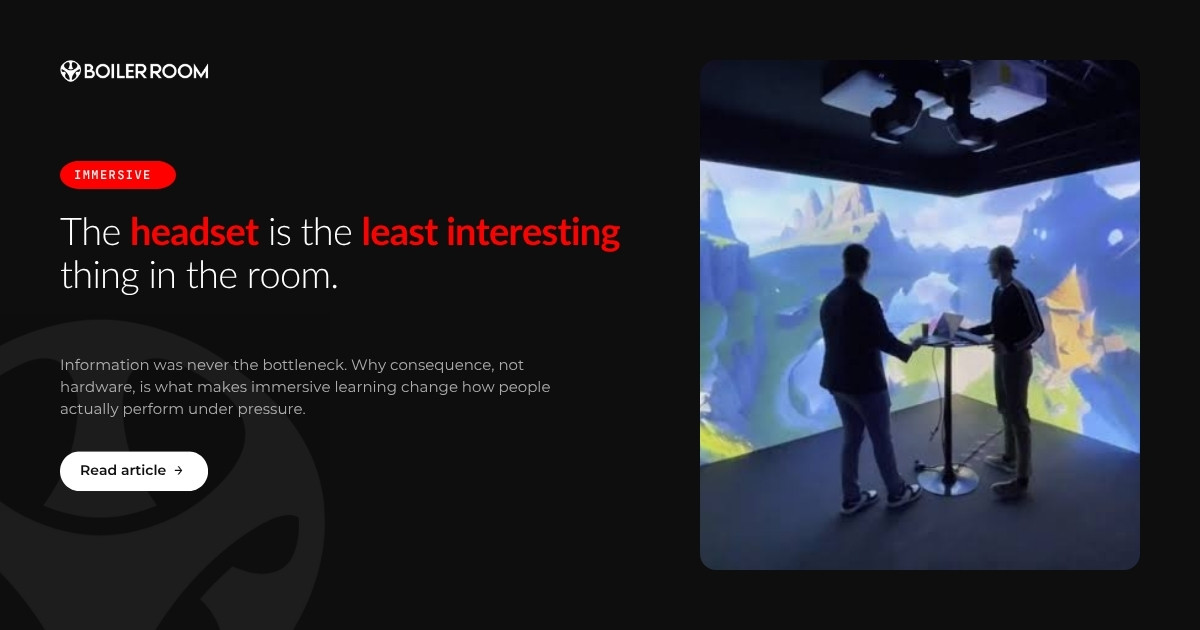
The organisations winning the future of learning are not the ones producing the most content. They are the ones creating the most believable experiences. That distinction matters more than most executives realise, and it has very little to do with the hardware sitting on someone's face.
For years, corporate training has operated on an assumption that was almost perfectly wrong: that information changes behaviour. Upload another PDF, schedule another compliance session, add another module to the LMS, and hope employees absorb enough to avoid expensive mistakes in the real world.
But that is not how humans learn. We learn through emotion, repetition, tension, consequence and participation. Pilots understand this. Surgeons understand this. Elite athletes have understood it for decades. Yet much of the industrial world still trains people as though the brain were a filing cabinet rather than an experience engine. Most organisations still measure whether training was completed rather than whether behaviour actually changed. Those are not the same metric.
Definition
Immersive learning is a training methodology that uses simulation, virtual reality and interactive digital environments to develop capability through experience rather than information exposure. The learner does not read about a procedure. They rehearse it.
Why does information keep failing as a training foundation?
Because passive consumption of information produces very little durable encoding. The brain does not treat information delivered without consequence the same way it treats information experienced through participation.
The answer is not that people are inattentive or unmotivated. Research from the World Economic Forum suggests nearly half of all employees globally will require reskilling within the next few years as digital transformation reshapes operational work. Traditional training systems are not built to handle that velocity of change.
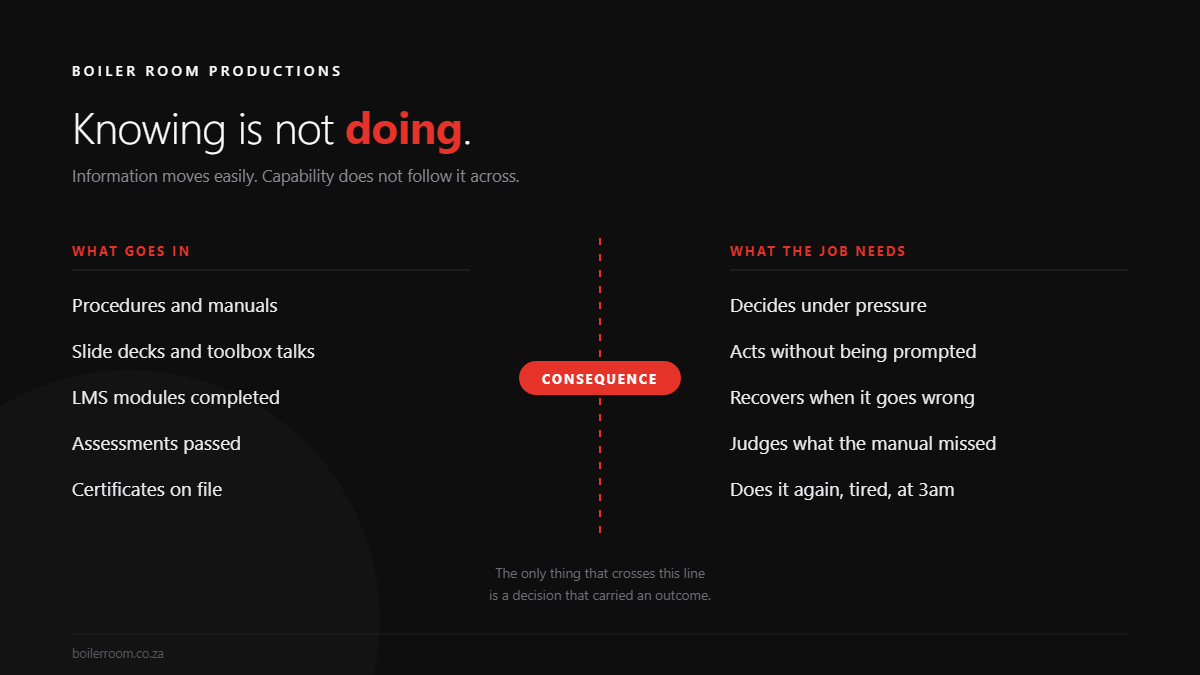
Traditional training was designed for a world where information itself was scarce. Employees needed manuals, guides and instructors because the content was not otherwise accessible. That world no longer exists. Employees can access procedures, tutorials and AI explanations from any device at any moment. Yet performance inconsistency, safety incidents and knowledge gaps have not disappeared in proportion to improved information access. Which suggests, uncomfortably, that information was never the real problem.
What makes immersive learning different from digital training?
The core distinction is not technology. It is consequence.
When learning carries consequence, when a wrong decision in a simulation produces an outcome with real feedback, the brain processes that experience through entirely different systems than it uses to read a slide deck. Decision making, situational awareness, emotional memory and behavioural response all activate together. Passive formats activate almost none of them.
When a mine worker enters a virtual environment and experiences the pressure of a high risk operational scenario before stepping underground, training stops being theoretical. Decisions carry weight. Mistakes become memorable without becoming dangerous. That is the value of immersive learning: consequence without danger. It closes the gap between knowing and doing, and those two things are not nearly as close as most training programmes assume.
What does the research actually say about immersive training outcomes?
That immersive learners build capability faster and apply it with far more confidence, and that the gap is structural rather than marginal.
Studies of virtual reality learning environments consistently find that immersive learners complete training substantially faster than classroom trained peers, and apply what they learned with markedly higher confidence. That is not a small improvement. It is a difference in how capability is built. Research across enterprise immersive environments points the same way: stronger knowledge retention, improved engagement, faster competency development and greater confidence under pressure.
The value is no longer hypothetical. It is commercial. Industrial businesses spend millions optimising equipment reliability while chronically underinvesting in the environments shaping how operators make decisions around that equipment. That imbalance is becoming harder to defend. Daniel Kahneman's work on decision making showed that people rarely operate through rational analysis under pressure. Stress, urgency and uncertainty shape behaviour long before logic catches up.
How does immersive learning address the attention problem in modern training?
By making it almost impossible to switch off. Simulation requires active participation, so it holds attention instead of competing for it.
Learning does not happen in isolation. It happens inside an attention economy where every training module competes against notifications, fatigue, production pressure and the general weight of operational work. Passive formats are maximally vulnerable to this. If the content does not command engagement, it does not encode. The learner is physically present and mentally elsewhere.
Immersive environments remove this option. You cannot scroll past a decision point inside a realistic operational scenario. The medium itself prevents the passivity that undermines most traditional training. This is one reason experts like Julie Dirksen emphasise that knowledge applied contextually produces substantially stronger retention than knowledge consumed passively, even when the passive content is higher quality.
What does the future of immersive workforce training look like?
It combines AI driven systems with adaptive simulation that responds to learner behaviour in real time, and it becomes the practical way to transfer experience as skilled operators retire.
Industrial companies are already building digital twins of facilities and machinery, allowing employees to train inside virtual replicas before entering live operational environments. As experienced operational workers retire across mining, manufacturing and logistics, immersive learning may become one of the few scalable methods capable of transferring institutional knowledge at the pace these industries require.
South Africa's industrial sectors face this challenge directly. Mining, energy, manufacturing and engineering organisations are all under pressure to modernise training while improving safety outcomes and accelerating workforce readiness. A generation of operators raised inside interactive digital environments will not learn effectively through static corporate communication.
The organisations investing now are not chasing technology trends. They are building the operational capability their competitors will not have in five years. The future of learning will not resemble classrooms translated onto screens. It will look like participation, simulation and interaction. It will feel operationally real before it becomes operationally real. The breakthrough is emotional fidelity, the feeling that what you are experiencing actually matters. That is not created by headsets. It is created by design. Where connectivity is the constraint, as it often is on a remote site, the same immersive courses run offline on BoilerBox 360 and sync back to the LMS once a connection returns.
Ready to build capability your teams can reach for under pressure?
We turn complex operational knowledge into immersive learning that changes behaviour, not just awareness.
Talk to Boiler RoomFrequently Asked Questions
What is immersive learning?
Immersive learning is a training approach that uses realistic simulations, VR and interactive environments to help employees learn through participation and experience rather than passive information consumption. The goal is to build capability, not just awareness.
Why is immersive learning more effective than traditional training?
Because it activates the systems in the brain that actually govern behaviour under pressure. Passive formats build awareness. Immersive formats build practised response. Those are not the same thing, and the difference shows up in performance outcomes, not just test scores.
How is VR used in workforce training?
VR training allows employees to practise procedures, safety protocols and operational tasks inside virtual environments before encountering them in reality. The value is rehearsal at scale, consistent, repeatable, consequence bearing practice without operational risk.
What industries use immersive learning in South Africa?
Mining, manufacturing, logistics, healthcare, engineering and energy sectors where safety outcomes and operational readiness directly affect business performance. The higher the stakes of the task being trained, the stronger the case for experiential approaches.
Can immersive learning improve workplace safety outcomes?
Yes. Workers who rehearse high risk scenarios in simulation arrive at live environments with practised responses rather than theoretical awareness. The difference in reaction time, confidence and behavioural consistency under pressure is measurable, and it shows up in incident rates.
Sources and Research
All cited research is current, drawn from 2024 and 2025 studies and reports.
- The Impact of Virtual Reality Immersion on Learning Outcomes (2025), Behavioral Sciences via PMC
- Virtual reality based training for health and occupational safety in Industry 4.0 (2025), Scientific Reports via PMC
- The Future of Jobs Report 2025, World Economic Forum

About the Author
Mark Hocker
Founder and CEO, Boiler Room
Mark Hocker is the Founder and CEO of Boiler Room, a South African immersive learning and VR training company. For over two decades he has helped mining, industrial and corporate teams replace passive content with immersive learning, using VR training, simulation based learning, digital twins and scenario based eLearning built for real operating conditions. He writes on immersive learning, workforce training and what genuinely changes behaviour on the job across South Africa’s high risk sectors.