Key Takeaways
- The crisis is knowledge, not labour. Experienced operators retire with judgement, intuition and situational awareness that no manual holds and no recruitment drive can rebuild.
- Traditional training only moves the easy part. It transfers explicit procedures well and misses the tacit expertise that actually keeps people safe.
- Immersive learning can encode a veteran's expertise. Their decision logic gets built into simulations, so the knowledge does not retire when the person does.
- The stakes are safety, not efficiency. As experience erodes, near-miss rates rise and hazard recognition slows. Immersive systems preserve the operational intelligence that keeps people alive.
Much of the conversation around workforce challenges in mining focuses on labour shortages, recruitment and skills development. What receives far less attention is the growing problem of knowledge transfer.
Across mining and industrial sectors, experienced operators, technicians and supervisors are retiring after decades spent developing highly specialised operational understanding. In many cases, organisations are not simply losing workers. They are losing judgement, intuition, procedural nuance and situational awareness that were built through years of direct experience.
This form of expertise is often difficult to document using traditional training methods. And until immersive training systems arrived, it was almost impossible to replace.
Definition
Immersive learning is a training methodology that uses simulation, virtual reality and interactive digital environments to develop capability through experience rather than information exposure. In mining, it is used to capture the tacit expertise of veteran operators before they retire.
What is the knowledge transfer crisis, and why is mining particularly exposed?
It is the accelerating loss of tacit expertise as veteran operators retire. Mining is especially exposed because so much of its safety rests on judgement built over decades underground, and that judgement cannot be refilled like a labour pipeline.
The scale is measurable. The Society for Mining, Metallurgy and Exploration projects that more than 221,000 mining workers in the United States, over half the current workforce, will have retired and been replaced by 2029, with 11,000 to 13,000 roles a year needing to be filled for two decades just to keep pace. In South Africa the Minerals Council reports the industry employs roughly 450,000 people directly, plus a further 250,000 in contractor roles. Every one of those is a headcount figure. None of them measure the thing that is actually leaving.
Traditional training models are effective at transferring procedural information. They are far less effective at transferring operational judgement developed under real world conditions.
When a mine brings in a new operator, they can follow a procedure manual. What they cannot follow is the instinct of a veteran who has spent twenty years reading the sounds, vibrations and behaviour of live equipment. That instinct lives in experience. It cannot be copied into a slide deck.
As workforce turnover accelerates across industrial sectors, organisations are confronting an uncomfortable possibility: decades of institutional expertise could disappear faster than conventional training systems can replace it. Labour pipelines can be refilled. Accumulated operational knowledge cannot be so easily rebuilt.
What is knowledge transfer in the workplace?
It is the process of passing operational knowledge, skills and judgement from experienced workers to newer ones. The hard part is tacit knowledge, the instinct and situational awareness that cannot be written down, which immersive learning is uniquely able to capture.
Why does traditional training fail to capture operational expertise?
Because it was built to transfer explicit knowledge, the part you can write down. The expertise that prevents incidents is tacit, developed through repetition under real conditions, and a manual cannot hold it.
The problem is structural. Traditional training was designed to transfer explicit knowledge: the kind that can be written down, standardised and tested. Safety protocols, standard operating procedures, regulatory compliance checklists. These are important. They are also the easy part.
The World Economic Forum's Future of Jobs Report 2025 puts a number on the pressure. Employers expect 39% of the skills workers need to change by 2030, and 59% of the global workforce will require training in that window. The figure worth sitting with is the last one. 11 in every 100 workers will need training they will not be able to access. The constraint is not recognition of the problem. It is delivery.
The harder part is everything that does not fit into a manual. The way an experienced haul truck driver adjusts their approach on a wet ramp based on years of feel. The way a maintenance technician hears a bearing about to fail before any instrument flags it. The way a shift supervisor reads the atmosphere of a team and knows something is off before an incident occurs.
This kind of expertise develops through repetition under real conditions. For decades it was passed down informally through proximity. Junior employees shadowed experienced ones. That model is now breaking down. As experienced personnel retire at scale, there are fewer mentors to shadow and less time to absorb what they know, at exactly the moment operational demand for that knowledge is highest.
What is the difference between explicit and tacit knowledge?
Explicit knowledge can be written down: procedures, rules, specifications. Tacit knowledge lives in experience and instinct, like sensing a machine is about to fail. Traditional training transfers the first well and the second poorly, which is the core of the mining knowledge crisis.
How does immersive learning preserve operational knowledge?
By letting people build competence through doing, and by encoding a veteran's decision logic into simulations that future workers interact with directly. The expertise stops retiring when the person does.
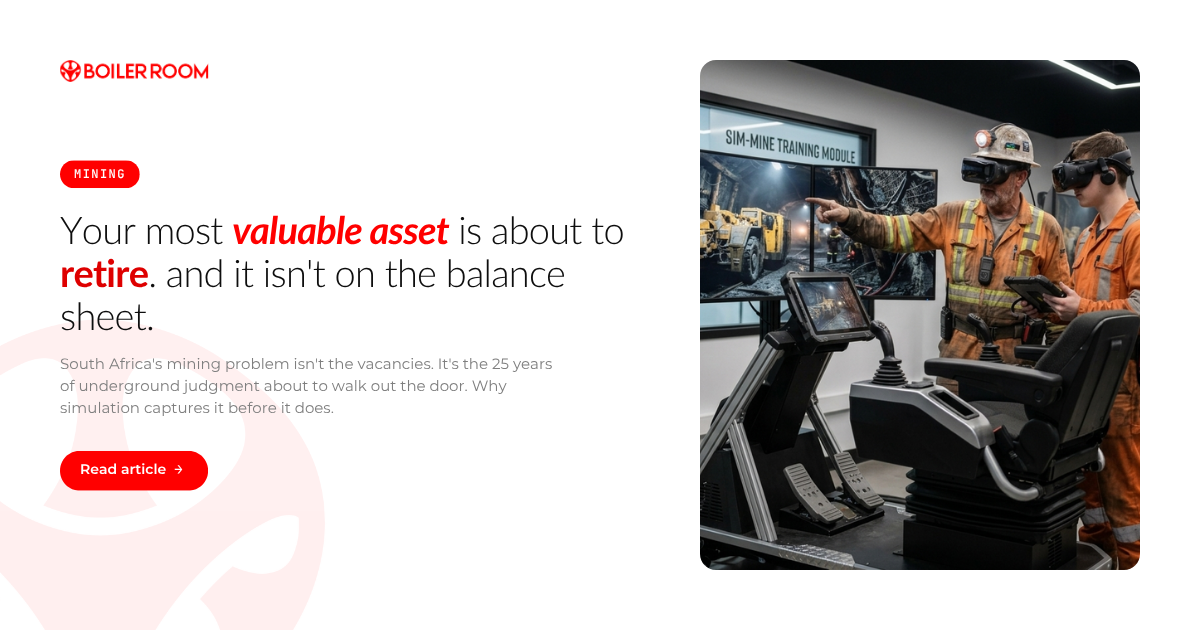
Virtual reality, simulation environments and interactive learning systems create opportunities to capture and replicate operational experience in ways traditional formats cannot. Instead of relying solely on written instruction, immersive systems let employees rehearse complex procedures, interact with simulated scenarios and develop familiarity with high risk situations before encountering them live.
At Boiler Room, immersive mining training systems recreate operational environments and emergency scenarios designed to support procedural understanding, behavioural confidence and experiential learning. Recent research backs the mechanism: a 2025 study of VR safety training in mining found measurable gains in knowledge retention, and separate 2025 work on procedural knowledge shows immersion helps most with the doing rather than the reciting.
The key difference is what the learner actually experiences. A written procedure tells you what to do. An immersive simulation puts you inside the situation and forces you to apply it. Muscle memory, spatial awareness, hazard recognition and decision speed all develop through doing, not reading.
Immersive environments can also encode the knowledge of retiring experts. A veteran's procedural approach, including the decision logic behind it, can be built into simulation scenarios that future employees interact with directly. This is the same experience over information principle explored in our piece on the real power of immersive learning. In this way, the expertise does not retire when the person does.
How do you retain knowledge from retiring employees?
Capture their decision logic and procedural approach while they are still on site, then encode it into experiences others can practise. Immersive simulations let a veteran's expertise live on as a scenario new employees rehearse directly, rather than as a document nobody reads.
What happens to mining operations when institutional knowledge disappears?
Safety erodes in ways that are easy to misattribute. Near miss rates climb, incident response slows, and new workers follow procedures correctly on paper while missing the context that makes those procedures work.
It shows up in the safety data too. NIOSH reports that more than 40% of the most serious injuries in mining, meaning fatalities and permanent disabilities, involve accidents classified as struck by or caught in machinery and powered haulage equipment. Those are exactly the situations where an experienced operator's judgement, the part that never made it into a manual, is what separates a close call from an incident.
The consequences extend well beyond operational efficiency. Safety culture, decision making quality and operational consistency all depend on accumulated experience distributed across a workforce.
When that experience erodes faster than it can be replenished, organisations begin to see effects that are easy to misattribute. Near miss rates may increase. Incident response may become slower or less confident. New employees may follow procedures correctly on paper while missing the contextual awareness that makes those procedures effective in practice.
The World Economic Forum's Future of Jobs Report 2025 highlights how workforce transformation and changing skill requirements are reshaping how organisations approach learning globally. Younger generations entering industrial sectors bring different learning expectations shaped by interactive digital environments. Organisations that recognise this early can design training that not only replaces lost knowledge but builds on it. This is where learning stops being an HR cost line and becomes strategic infrastructure.
Can VR replace on-the-job training in mining?
It does not replace it, it compresses it. VR lets new workers build situational familiarity and practised responses safely before their first shift, so on site time is spent refining competence rather than acquiring it from scratch.
How is immersive training addressing the knowledge gap in South African mining?
By rebuilding South Africa's specific operational conditions, deep level hazards, CAS zones and generational transition, as immersive scenarios. Boiler Room treats knowledge transfer as a systems problem, not a content problem.
South African mining operates in one of the world's most operationally and regulatorily complex environments. Deep level mines, high risk vehicle interaction zones, collision avoidance system (CAS) requirements and a workforce in significant generational transition all compound the knowledge transfer challenge.
Immersive training systems built specifically for mining address several of these pressures at once. Emergency response scenarios let new operators develop situational familiarity without exposure to live risk. Simulation environments replicate equipment behaviour and operational conditions in ways printed materials cannot. Repeated procedural rehearsal builds the internalised competence that previously only came from years on site.
Boiler Room's VR training programmes and simulation environments are designed to work within the specific operational context of South African mining. It is purpose built immersive training that treats knowledge transfer as a systems problem, not a content problem. Where connectivity is the constraint, the same courses run offline on BoilerBox 360 and sync back once a connection returns.
Why is immersive learning better for high-risk industries?
Because in high risk work the gap between knowing a procedure and performing it under pressure is where incidents happen. Immersive learning builds practised, reliable behaviour through doing, which is exactly what safety critical environments require.
Preserve the expertise before it walks out the door.
We help mining teams capture the operational knowledge of retiring experts and turn it into immersive scenarios new operators can rehearse.
Talk to Boiler RoomFrequently Asked Questions
What is the knowledge transfer crisis in mining?
It refers to the accelerating loss of operational expertise as experienced workers retire. Much of this expertise is tacit: embedded in intuition, pattern recognition and situational awareness developed over years of direct experience. When those workers leave, the knowledge leaves with them, and conventional training cannot replace it at pace.
Why is tacit knowledge so difficult to transfer through traditional training?
Tacit knowledge exists in behaviour and experience rather than in documents. Traditional training delivers explicit knowledge effectively: procedures, rules, compliance checklists. It is far less effective at transmitting the contextual judgement, hazard recognition and operational instinct that define true expertise.
How does VR training help preserve mining expertise?
VR and simulation based training capture the procedural logic, decision pathways and scenario specific behaviours of experienced operators and encode them into interactive environments. New employees can rehearse those scenarios repeatedly, developing situational familiarity and internalised competence that would previously have required years of on site exposure to acquire.
What are the operational risks of not addressing knowledge transfer in mining?
Organisations that fail to address it risk losing not only technical capability but institutional resilience. Safety culture, operational consistency and effective hazard response all depend on accumulated experience. As that experience erodes, near miss rates can rise and incident response quality can decline.
Is immersive training suitable for South African mining operations?
Yes. Immersive training systems purpose built for mining, such as those developed by Boiler Room, are designed to reflect the operational environments, equipment types and compliance requirements specific to South African mining. They are not repurposed corporate eLearning.
Sources and Research
All cited research is from 2025.
- World Economic Forum, Future of Jobs Report 2025
- The Impact and Effectiveness of Virtual Reality Applied to Safety Training of Workers in Open-Cast Mining (2025), PMC
- Virtual Reality Immersion on Learning Outcomes: Declarative vs Procedural Knowledge (2025), PMC
- ICMM, Health and Safety performance data
- Society for Mining, Metallurgy and Exploration, Workforce Trends in the US Mining Industry
- Minerals Council South Africa, Facts and Figures 2025
- NIOSH, Mining and Machinery Struck By Injuries

About the Author
Jamie Collins
Knowledge Transfer and Immersive Learning in Mining, Boiler Room Productions
Jamie Collins is Partnerships Manager at Boiler Room, a South African immersive learning and VR training company. He works with mining and industrial teams on knowledge transfer, safety training and simulation based learning that preserves the operational expertise experienced operators take with them when they retire. He writes on immersive learning, mining training and workforce readiness across South Africa.