Key Takeaways
- VR training is rehearsal, not demonstration. The learner performs the task and lives with the outcome, which is a different mechanism to watching a video of it.
- It earns its place in a narrow band. Four conditions justify it: when the real thing is dangerous, impossible, counterproductive to stage, or prohibitively expensive to repeat. Outside those, simpler formats do the job for less.
- The evidence is strongest for procedural skill. A 2025 study found immersion helped most with doing rather than reciting, which is exactly the gap that matters in operational work.
- Content drives cost, not hardware. Headsets are the visible line item and the smallest one. The number that matters is time to competency, not price per licence.
Most explanations of VR training answer a question nobody is really asking. They describe the hardware, list the benefits, and stop.
The question organisations actually have is narrower and harder. Given a training problem, is virtual reality the right tool for it, and how would anyone know afterwards whether it worked?
That is the version of the question worth answering, and it is the version most of the internet skips.
Definition
VR training is a learning method that places people inside a realistic, interactive digital environment where they practise tasks, procedures and decisions under conditions close to the real ones. The learner does not read about a procedure or watch someone perform it. They perform it, and the environment responds.
What is VR training?
VR training places learners inside a simulated work environment where they can interact with equipment, practise procedures and make decisions that carry consequences. These experiences can be delivered through VR headsets, immersive screens or interactive 3D simulations using physical controls. The purpose is to build practical capability before someone encounters the situation for real, rather than simply delivering information about it.
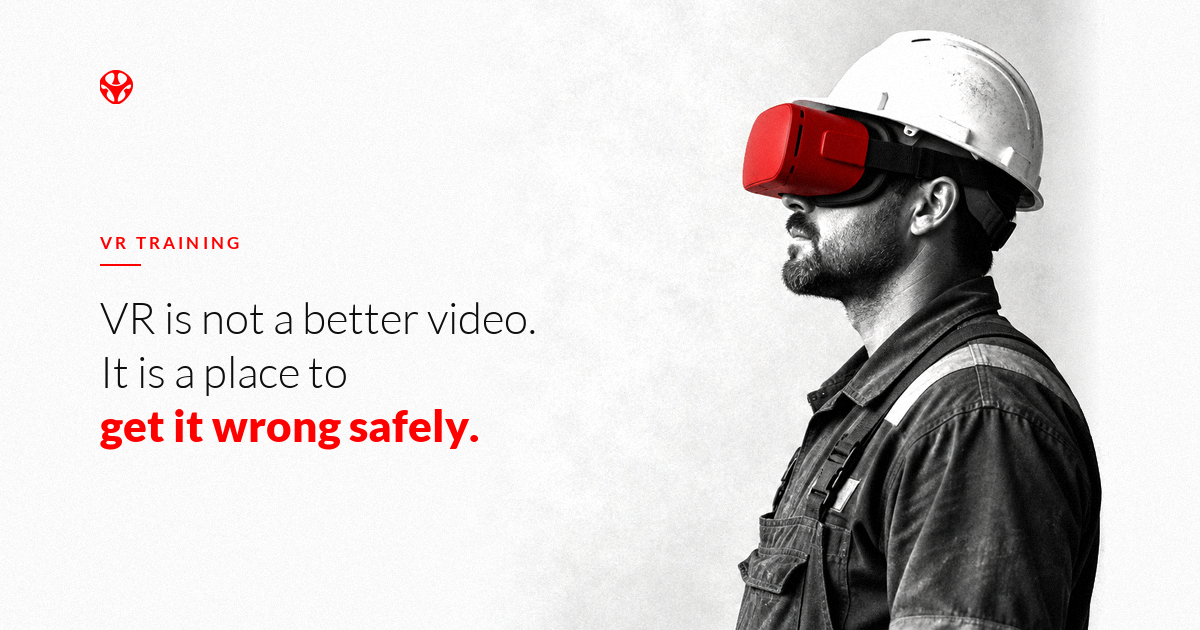
The distinction that matters is between exposure and participation. A video shows a procedure. A manual describes it. A simulation requires the learner to carry it out, get it wrong, and try again.
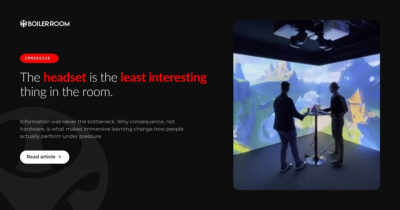
That difference is not cosmetic, and it is the reason the headset is the least interesting part of the room. When a decision produces an outcome, even a simulated one, the learner is doing something structurally different to reading. They are building a response they can reach for later, under pressure, without being prompted. We set out the underlying argument in why immersive training beats information.
Scenarios range from short familiarisation exercises through to detailed emergency response, equipment operation, hazard recognition and decision making under time pressure.
How does VR training work?
Learners enter an interactive 3D environment designed to replicate real workplace conditions. Depending on the training application, they may use a VR headset, an immersive display or a desktop simulation, interacting through hand controllers, physical equipment controls or other input devices. Their actions influence what happens in the simulated environment, allowing them to practise procedures, make decisions and experience the consequences. The system can track their performance, provide feedback and allow them to repeat scenarios to improve their capability.
Regardless of how the experience is delivered, three things have to be right for immersive training to work.
- The environment has to be recognisable. Not photorealistic, recognisable. A learner needs to believe the space behaves like the one they work in, and that belief comes from correct layout, correct equipment behaviour and correct sequence far more than from resolution.
- The scenario has to carry consequences. If nothing happens when the learner does the wrong thing, the simulation is an expensive slideshow.
- And the experience has to be repeatable. Capability comes from doing it again, not from doing it once impressively.
What is the difference between VR, AR, MR and XR?
VR replaces what you see with a fully digital environment. AR overlays digital content onto a live camera view of the real world. MR lets the digital and physical interact, so a virtual object can sit behind a real table. XR is the umbrella term covering all three.
The terms get used loosely, including by vendors, and the confusion has a practical cost. An organisation that asks for VR and buys an AR overlay has not bought rehearsal, it has bought a reference tool.
| What the learner sees | Where they physically are | Best used for | Weak for | |
|---|---|---|---|---|
| VR | A fully digital environment. The real room is gone. | Anywhere safe with room to move | Rehearsing procedures that cannot be practised for real | Tasks that must be done on the actual equipment |
| AR | The real world with digital information layered on top | At the real task, in the real place | Guidance, checklists and reference at the point of work | Building capability before someone arrives |
| MR | Real and digital objects that interact with each other | At the real task, with digital props | Complex assembly and maintenance where both matter | Emergency scenarios that need a controlled setting |
| XR | The umbrella term for all three | Not a technology, a category | Talking about the field | Writing a specification, it is too vague to buy |
For training purposes the useful test is what the learner is doing with their hands and attention. Full immersion suits procedures that require the person to be somewhere else. Overlays suit tasks performed in the real environment where the digital layer is guidance, not substitution.
If a supplier proposal says XR without saying which of the three, ask. The word covers technologies that solve different problems and cost different amounts.
Where does VR training actually earn its place?
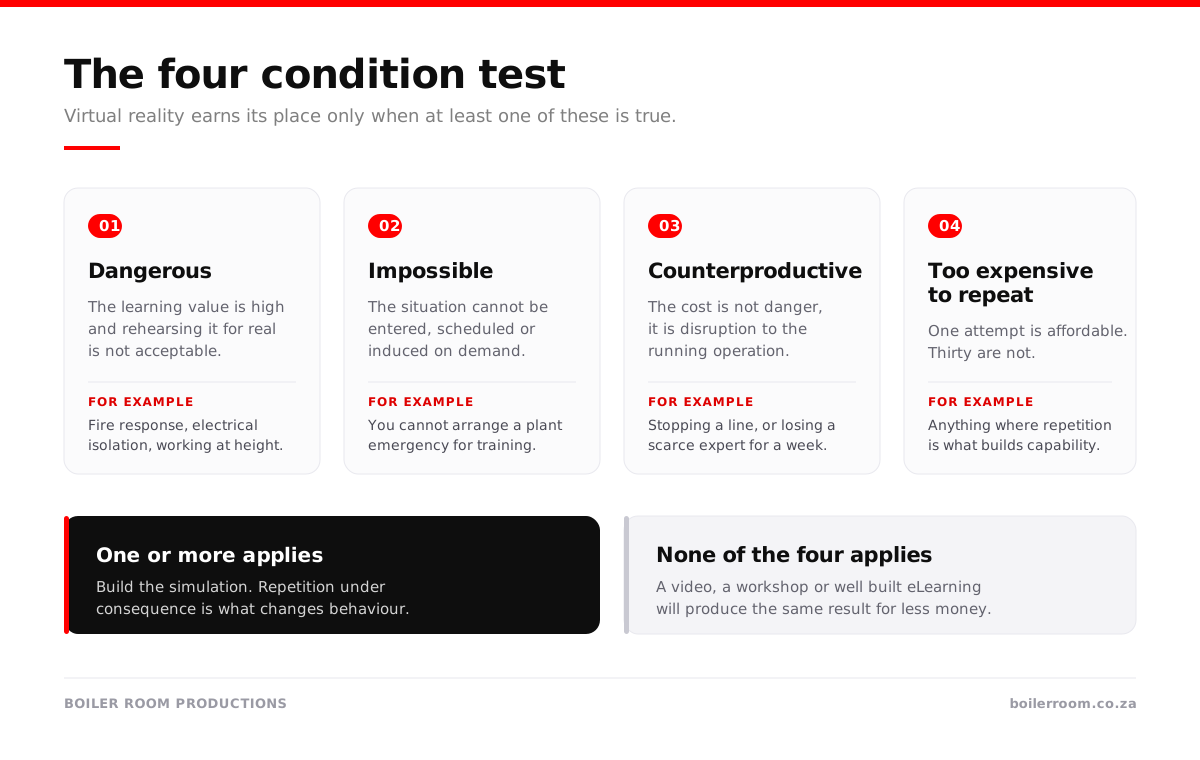
Virtual reality is worth the build when the real thing is dangerous, impossible, counterproductive or prohibitively expensive to stage repeatedly. If none of those four apply, a video, a workshop or a well built eLearning module will produce the same result for less money.
Call it the four condition test. It is the fastest way to sort a genuine VR case from an enthusiastic one.
Dangerous. Fire, electrical isolation, working at height, confined space, vehicle interaction. Situations where the learning value is high and the rehearsal cost in the real world is unacceptable.
Impossible. Environments that cannot be entered, events that cannot be scheduled, failures that cannot be induced. You cannot arrange a plant emergency for training purposes.
Counterproductive. Training that would stop production, damage equipment or consume a scarce expert's week. The cost is not danger, it is disruption.
Prohibitively expensive to repeat. Anything where one attempt is affordable and thirty are not. Repetition is where capability comes from, so a format that only allows one run is not really a training format.
The interesting consequence of the test is how much it rules out. Most corporate training fails all four conditions, and should. A high price tag on a training method is no evidence that it works, and the enthusiasm around a technology is usually a poor guide to where it pays.
What is VR training used for?
The four most common applications are safety and emergency response, equipment and machinery operation, behavioural and decision making skills, and onboarding or site induction. All four share the same shape: a task where doing it matters more than knowing about it.
Safety and emergency response. Hazard recognition, evacuation, spill response, working at height, confined space entry, isolation procedures. Learners meet the situation, make a call and see what follows.
Equipment and machinery. Familiarisation before a learner touches a live machine. Inspection routines, start up sequences, maintenance procedures and fault diagnosis, practised without taking the asset out of service.
Behavioural and decision making skills. Difficult conversations, escalation, leadership under pressure, team coordination. The scenario supplies the pressure that a role play in a training room usually cannot.
Onboarding and induction. New starters walk the site before their first day, learn the layout, meet the rules in context and arrive already oriented.
Which industries use VR training?
Healthcare, manufacturing, logistics, energy and utilities, corporate learning and mining are the main adopters. The common factor is not the sector, it is the stakes: the higher the cost of getting a task wrong the first time, the stronger the case for rehearsing it.
In healthcare, clinical procedure rehearsal and emergency response simulation, where practising on a patient is not an option. The 2025 study cited below used exactly this setting, CPR training, to test whether immersion helps.
In manufacturing, machine operation, changeover procedures and maintenance training that would otherwise require stopping a line.
In logistics and warehousing, vehicle and pedestrian interaction, materials handling and racking safety.
In energy and utilities, high voltage work, isolation and complex technical procedures where the environment itself is the hazard.
In corporate and enterprise learning, leadership development, difficult conversations, compliance scenarios and onboarding at scale across sites.
In mining, emergency response, equipment familiarisation and high risk procedure training. It is the sector most associated with it in South Africa, though it is no longer the only one investing.
How much does VR training cost?
Cost splits into three parts: hardware, content and running the programme. Hardware is the smallest part. Custom scenario content is the real driver, and device management is the line most quotes leave out entirely.
What drives VR training cost in South Africa comes down to three things. A standard VR experience needs a standalone headset, its controllers and charging equipment before any experience is loaded onto it. Tactile VR, where real equipment such as a fire extinguisher or a pinch bar is linked to the headset and controllers, costs considerably more, and the tactile equipment itself shapes that cost. The biggest part is usually the content: how many scenarios, how much of your site and equipment is modelled, how many decision points, and whether results flow back into your LMS. Every programme is scoped to the training need, which is why Boiler Room Productions quotes per project, and why cost per competent worker is the better yardstick than the price of a headset.
Content. This is where the money actually goes and where a single quoted figure is meaningless. What moves it: how many distinct scenarios, whether your equipment has to be modelled from scratch or adapted from an existing asset, how many decision branches each scenario carries, whether it needs multi user support, and whether assessment data has to flow back into an LMS. A single linear familiarisation scenario and a branching multi user emergency drill are different projects by an order of magnitude. Any supplier quoting content before scoping those five things is guessing.
Running it. Device management, firmware updates, content updates as procedures change, replacement units, and the internal time to schedule sessions and interpret results. This recurs annually and it is routinely left out of the business case, which is why year two is where VR programmes quietly die.
Anyone quoting a single figure is quoting for a product, not a programme.
The useful way to frame the question is cost per competent worker rather than cost per licence or per headset. Take the full three year cost, divide by the number of people who reach competency, and compare that against what the same competency costs you through classroom time, live equipment hours and supervised shadowing. That comparison is the one that decides it, and almost nobody runs it.
The honest question to put to any supplier quote is what happens in year two.
If you want a number for your own programme, ask Boiler Room Productions for a quote scoped to the task you need to train.
Is VR still worth it in 2026?
Yes, in the narrow band the four condition test describes, and increasingly so as the hardware stops being the interesting part. What has changed is not the technology, it is that the workforce problem VR addresses has become more acute.
The World Economic Forum's Future of Jobs Report 2025 found that employers expect 39% of the skills workers need to change by 2030, and that 59% of the global workforce will require training within that window. The number worth sitting with is the third one. 11 in every 100 workers will need training they will not be able to access.
That is a delivery problem, not an awareness problem. It is also the strongest current argument for methods that compress how long capability takes to build.
The counterargument is worth stating honestly. In our work, VR pilots stall more often than they scale, usually because the organisation bought hardware and treated content and measurement as afterthoughts. The technology is rarely what fails.
How do you know whether VR training worked?
Track time to competency, meaning how long before a person performs the task correctly without being prompted. Completion rates and attendance prove a programme ran. They have never measured whether anyone can act.
This is where most VR business cases quietly fall apart. The pilot is judged on enthusiasm and completion, both of which will look excellent, and neither of which tells you anything about capability.
The measures that do tell you something are unglamorous. Time to competency. Error rate on first live attempt. How long the improvement holds at ninety days. Whether supervisors stop shadowing the person.
Research supports the mechanism rather than the marketing. A 2025 comparative study found that higher immersion improved acquisition of procedural knowledge, the doing, more clearly than declarative knowledge, the reciting. Separate 2025 work on VR based training for health and occupational safety in Industry 4.0 points the same way.
Notice what that finding implies. If your training problem is that people do not know something, VR is an expensive way to solve it. If the problem is that they know it and still do not do it, VR is aimed at the right target.
Where to start
If you are weighing it up, run the four condition test on the specific task first, not on the technology. Then ask what you would measure to know it worked, and only then talk to anyone about headsets.
We build VR and XR, simulation, digital twin and eLearning environments for organisations across industrial, healthcare, logistics and corporate settings. Where connectivity is the constraint, the same courses run offline on BoilerBox 360 and sync once a connection returns.
Tell us about the task you are trying to train.
Talk to Boiler Room ProductionsFrequently Asked Questions
How much does VR cost in South Africa?
It depends on what the training needs: a standard headset setup or tactile VR with real equipment linked in, how much custom content has to be built, and what it takes to run the programme each year. Boiler Room Productions quotes per project, scoped to the training need, so compare quotes on cost per competent worker rather than on the hardware.
How is VR used in teaching and training?
In education and workplace training, VR is used for procedure rehearsal, hazard recognition, clinical simulation, equipment familiarisation and scenario based decision making. It works best where a learner needs to practise doing something rather than learn facts about it, which the 2025 research on procedural knowledge supports.
Do you need a headset for VR training?
Not always. Fully immersive rehearsal needs a headset, but the same scenario content can often be delivered on desktop, tablet or touchscreen for familiarisation and refresher use. Many programmes run both, using headsets for the high stakes rehearsal and screens for scale.
Can VR training run without internet access?
Yes. Offline platforms such as BoilerBox 360 deliver immersive training on remote, underground or low connectivity sites and synchronise completion records once a connection returns. This matters wherever the training is most needed exactly where the signal is worst.
What is the difference between VR training and VR safety training?
VR training is the broad category covering onboarding, technical skills, equipment operation and behavioural development. VR safety training is the subset focused on hazard recognition, emergency response and safe working procedure. The build method is the same. The scenario design and the measures of success are not.
Sources and Research
All cited research is from 2025.
- The Future of Jobs Report 2025, World Economic Forum
- The Impact of Virtual Reality Immersion on Learning Outcomes: A Comparative Study of Declarative and Procedural Knowledge Acquisition (2025), Behavioral Sciences via PMC
- Exploring the effectiveness of virtual reality-based training for sustainable health and occupational safety in Industry 4.0 (2025), Scientific Reports via PMC

About the Author
Mark Hocker
Founder and CEO, Boiler Room Productions
Mark Hocker is the Founder and CEO of Boiler Room Productions, a South African VR training and immersive learning company. He has spent more than two decades building VR training, simulation and digital twin environments for industrial, healthcare, logistics and corporate teams, working to a simple rule: virtual reality earns its place only where the real thing is dangerous, impossible, counterproductive or too expensive to repeat.