The right learning platform for training providers in South Africa is the one that can produce a named learner's assessed record, for a specific risk, the day someone asks for it, even if that learner trained where there was no signal. Judge every platform on that test first.
Key Takeaways
- A training provider buys a platform to prove competence, one learner at a time, so five needs decide the choice, from evidence-grade assessments to refresher reminders.
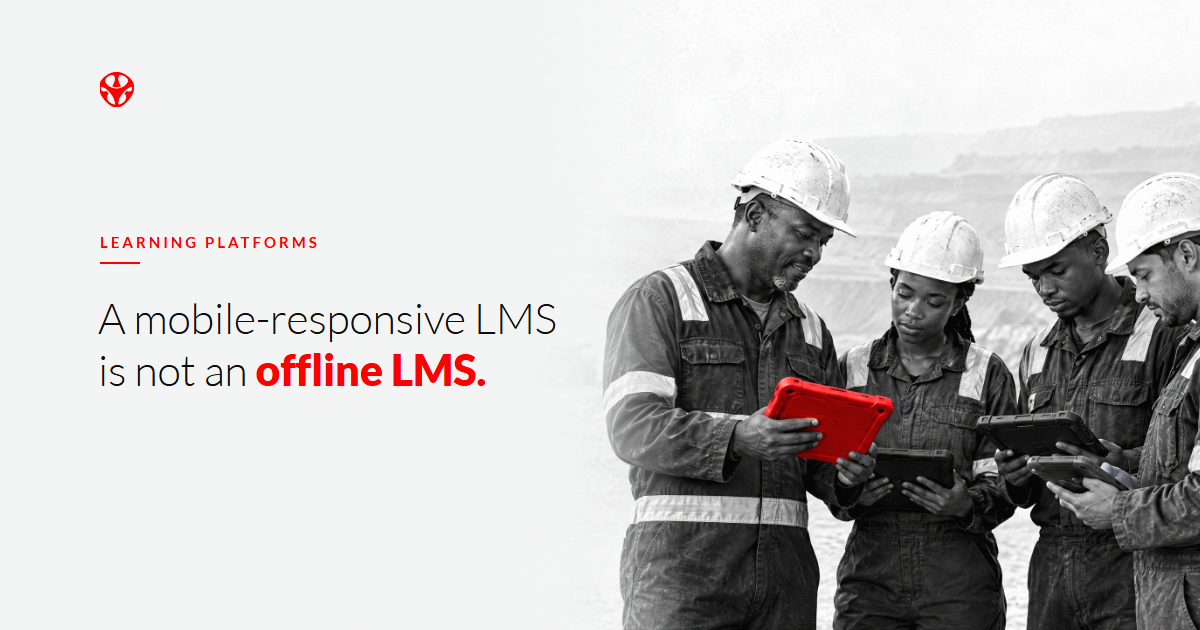
- A mobile-responsive LMS is not an offline LMS. Syncing results, not playback, is the hard part.
- A training record you cannot produce after an incident was never a control. It was compliance theatre.
Definition
A learning platform for a training provider is the system that delivers courses, runs assessments and keeps a dated record of every learner's results. Its real job is evidence: who was trained, on what, when, and how they were assessed.
Who is choosing a learning platform, and what are they really buying?
The buyers of a learning platform in South Africa are accredited training providers, SETA-funded learnership programmes, internal company academies and contractors who train crews on mine sites. Each is buying the same thing: the ability to show, for one named person, that they were trained and assessed for the work they do.
Somewhere a person is about to do work that can hurt them, and the provider has promised they are ready. The platform is how that promise is later proven.
In mining, the Minerals Council South Africa puts 2025 employment at nearly 469,000 people in its Facts and Figures 2025 Pocketbook. When experienced people leave, their knowledge leaves too, a problem we unpacked in mining's hidden workforce crisis.
What does a learning platform for training providers need to do?
A training provider needs five things from a learning platform: assessments that stand up as evidence, a complete record per learner, QCTO and SETA reporting, support for multilingual and low-literacy learners, and refresher reminders. Test each one in the demo with your own data, not the vendor's.
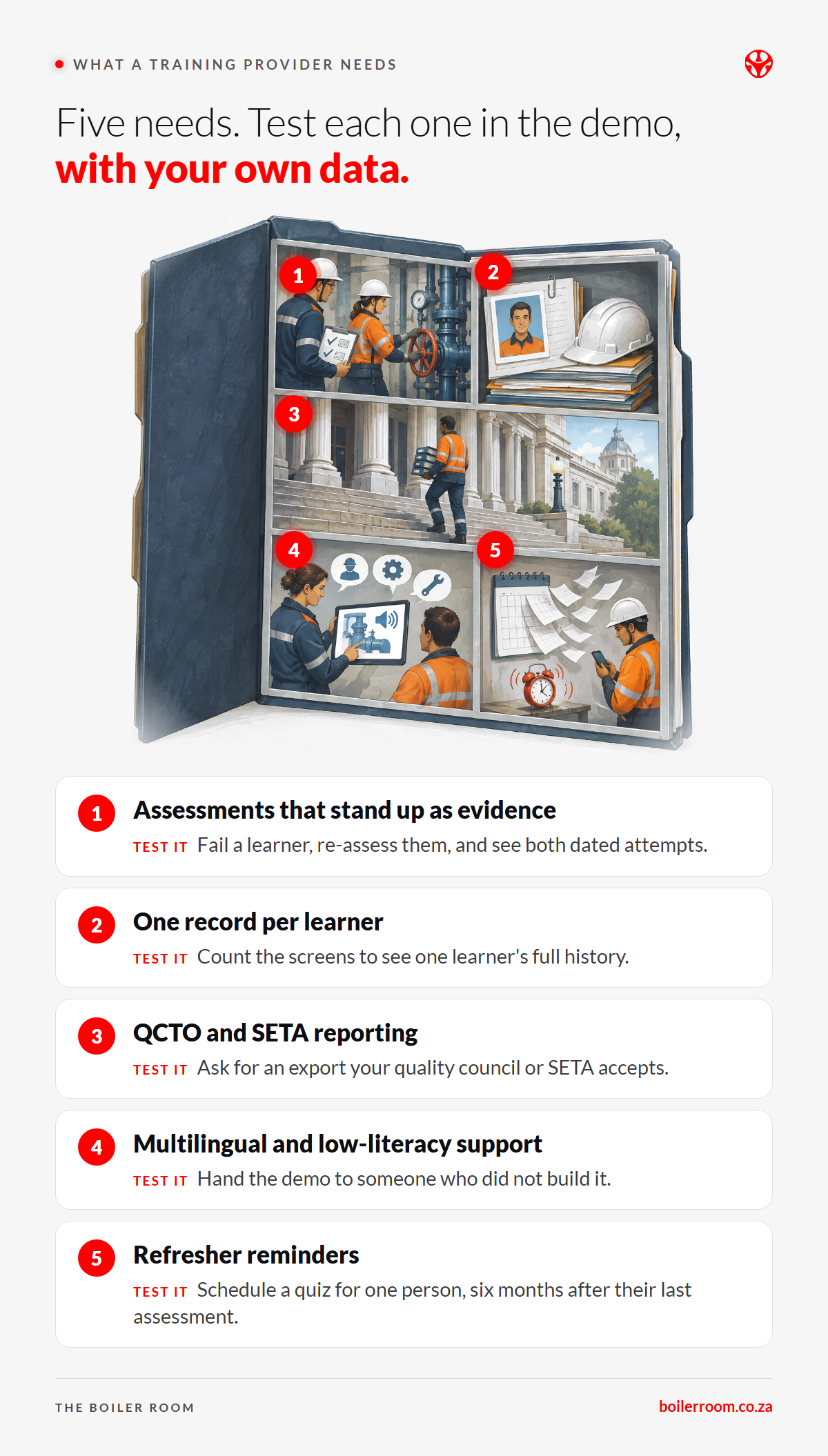
- Assessments as evidence. The QCTO's provider guide, The Road to Success (October 2024), requires formal assessment on every module, with re-assessment dates and outcomes recorded. Test it: fail a learner, re-assess them, and see both dated attempts.
- One record per learner. Results, workplace evidence and statements of results under one ID. Test it: count the screens to see one learner's full history.
- QCTO and SETA reporting. Occupational qualifications run through QCTO-accredited providers; SETAs fund learnerships and, in mining, the MQA receives the employer's skills plan and training report by 30 April. Test it: ask for an export your quality council or SETA accepts.
- Multilingual and low-literacy support. Audio, pictures and short screens in the learner's language. Test it: hand the demo to someone who did not build it.
- Refresher reminders. Skills fade. A 2025 meta-analysis in Psychological Bulletin by Tatel and Ackerman found that, without use, about half the accuracy gained in a procedural skill was gone after about 6.5 months. An annual refresher arrives too late. Test it: schedule a quiz for one person, six months after their last assessment.
Seat time misleads too: in TalentLMS's 2026 L&D Report, a US survey of 1,000 employees, 70% said they multitask during training. Simulator results belong in the same learner record as quizzes, or your VR training evidence sits in a separate silo.
Cloud LMS or offline LMS: which fits your sites?
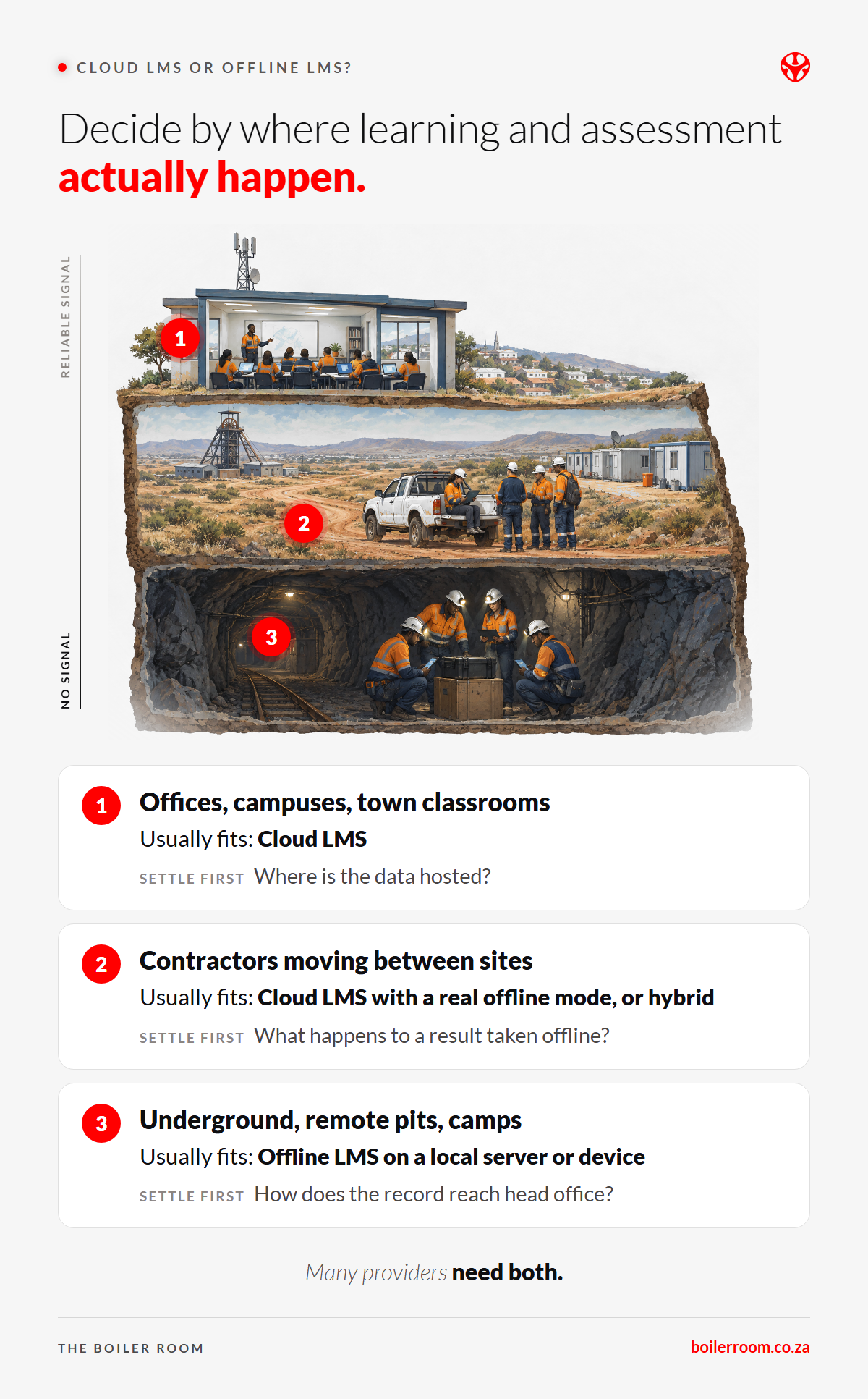
A cloud LMS fits learners with reliable internet, such as a corporate academy or a provider training in town. An offline LMS fits crews underground or on contractor camps, where signal is weak or absent. Many providers need both. Decide by where learning and assessment actually happen.
| Where your learners are | What usually fits | Settle this first |
|---|---|---|
| Offices, campuses, town classrooms | Cloud LMS | Where is the data hosted? |
| Contractors moving between sites | Cloud LMS with a real offline mode, or hybrid | What happens to a result taken offline? |
| Underground, remote pits, camps | Offline LMS on a local server or device | How does the record reach head office? |
ICASA's State of the ICT Sector Report (31 March 2026) puts 4G population coverage at 99.5%, counted by inhabitants within range of a signal. That is a map of where people live, and nobody lives 1,000 metres underground.
What changed in 2026: offline-first is now mainstream
On 18 August 2026 Cornerstone, a large learning platform vendor, launched the DisasterReady mobile app so humanitarian workers can download courses and learn with little or no connection.
Cornerstone's press release says DisasterReady has reached more than 1.5 million learners in 195 countries.
Our answer for sites without signal is BoilerBox 360, a small, portable, plug-and-play learning server that runs courses and assessments with no connection. We built it because the sites that most needed training were the ones where cloud platforms stopped working.
Why is syncing harder than playback?
Playing a course offline is easy: download it and press play. Syncing is hard, because every attempt, score, re-assessment and sign-off taken offline must reach the central record once, in order, with the right date, and without duplicates or gaps. That record is what an inspector will ask to see. Cornerstone's release does not describe how results sync. Moodle's mobile app documentation says offline actions are stored "with the synchronisation time" (Moodle Docs, edited 16 April 2026). A worker passes an assessment underground on Tuesday. The device syncs on Friday. An incident happens on Wednesday. The record says the worker was assessed after the incident. Call it the time-travel problem. Every offline LMS has to solve it. Ask yours how.
Will your training records hold up after an incident?
Training records hold up after an incident only if they show each employee's formal training on the risks in the mine's own risk assessment. The Mine Health and Safety Act already requires a record of formal training per employee. Dates and assessment results make it evidence; a platform that cannot produce it fast has not reduced your risk.
Section 10(2) of the Mine Health and Safety Act 29 of 1996 requires every employee to be "properly trained" for every risk in their work that "has been recorded in terms of section 11", the mine's own risk assessment. Our reading: that makes training site-specific. Section 10(4), added by the Mine Health and Safety Amendment Act 74 of 2008, says: "The employer must keep a record of all formal training provided in respect of each employee in terms of subsection (2)."
A Bill before Parliament would go further: the Mine Health and Safety Amendment Bill B10-2026, introduced on 7 April 2026, would require the employer to "keep and make available" the record "to the inspector", and would define formal training as training that is "properly structured, documented and assessed". It is not law: on 28 October 2026 it was still before the National Assembly.
Under that definition, undocumented, unassessed training would not count as formal training. A generic module with a completion tick, delivered to a contractor who cannot show it afterwards, is compliance theatre: it looks like a control and does none of a control's work.
On our projects we use continuous assessment, formal and informal, throughout a course, and add an acknowledgement step where the learner confirms they can do the task, so the learner also takes accountability for their learning.
Off-the-shelf content or custom content?
Off-the-shelf content suits general topics that do not change between sites, such as first aid basics or POPIA awareness. Custom content suits anything tied to your own risk assessment, equipment or procedures, which in mining is most of what matters. Most providers need a platform that carries both.
A library course on working at heights does not know your shaft or your escape route. Because section 10(2) links training to recorded risks, content closer to the real site makes stronger evidence, which is how our eLearning development team builds custom modules. Buy generic where generic is honest; build where it is not.
What drives the cost of a learning platform?
The cost of a learning platform comes from licences or hosting, set-up and integration, the content, devices and offline hardware, and support and reporting over the years you run it. Content build is usually the biggest part. The Boiler Room quotes per project.
Judge it over three years. The line buyers most often forget is upkeep: when a procedure or a machine changes, the module and its assessment change with it. ATD's 2026 State of the Industry report, drawn mostly from US organisations, found formal learning hours per employee rose from 13.7 to 16.7 in 2025 while direct spend per employee fell. More hours on less money puts pressure on what a platform costs to run.
What should you ask a vendor before you sign?
Before you sign, ask the vendor to prove the record rather than show the content. Use the six questions below. The last one matters most: ask for one learner's record, for one risk, from a site with no signal, as an inspector would.
- If a learner is assessed offline, does the record keep the time they did it or the time it synced?
- What happens when two devices sync conflicting results for one learner?
- Which export formats do you produce for QCTO, our SETA and the MQA?
- Where is our learners' personal information stored, and how is it encrypted and backed up?
- Can it run a short quiz in isiZulu, Sesotho or Setswana, with audio?
- Show me one learner's record, for one risk, from a site with no signal, as an inspector would ask for it.
If the last answer is a pause, you have your answer. Our eLearning platforms team will test your own sites against these questions with you, or talk to us directly.
Tell us about the sites you need to train.
Talk to The Boiler RoomFrequently Asked Questions
Can an LMS work without internet?
Yes. An LMS works without internet when it runs on a local server or on the device itself and keeps results there until a connection returns.
Is there a free LMS?
Open-source learning management systems carry no licence fee, but hosting, set-up, content, support and reporting still cost money.
What is the difference between a learning management system and a learner management system?
A learning management system delivers courses and assessments and records results. A learner management system, as South African providers use the term, handles admin such as enrolments, QCTO data loads and statements of results. When you compare learning management system South Africa options, check which of the two jobs each one does.
Can a small offline server run an LMS?
Yes. A small, portable learning server can host a lightweight learning platform over its own local Wi-Fi network. BoilerBox 360 runs an LMS this way, and we have tried and tested it.
Is an offline LMS POPIA compliant?
It can be. POPIA section 19 requires reasonable security safeguards wherever records sit. Keeping data on site avoids cross-border transfer questions under section 72 but moves the risk to device security, so encryption and backups matter more. Not legal advice.
Can a learnership be done online?
Partly. The knowledge component can often be delivered online or blended if the qualification's curriculum allows it. Our reading of the QCTO guide is that the workplace component and the external assessment are not delivered through the platform. Check your curriculum document, and legacy qualification dates on the SAQA register.
Sources and Research
- Minerals Council South Africa, Facts and Figures 2025 Pocketbook, 2026.
- Quality Council for Trades and Occupations, The Road to Success: The Skills Development Provider's Guide, Version 2, October 2024.
- Tatel, C.E. and Ackerman, P.L., Procedural skill retention and decay: a meta-analytic review, Psychological Bulletin, 2025.
- TalentLMS, The TalentLMS 2026 L&D Report, December 2025.
- ICASA, The State of the ICT Sector Report of South Africa, 31 March 2026.
- Cornerstone, DisasterReady mobile app press release, 18 August 2026.
- Moodle Docs, Moodle app offline features, edited 16 April 2026.
- Mine Health and Safety Act 29 of 1996, sections 10(2) and 11 (original text).
- Mine Health and Safety Amendment Act 74 of 2008, which added section 10(4).
- Parliament of South Africa, Mine Health and Safety Amendment Bill B10-2026, introduced 7 April 2026.
- ATD, 2026 State of the Industry, May 2026.

About the Author
Mark Hocker
CEO and Founder, The Boiler Room
Mark Hocker is CEO and Founder of The Boiler Room and the architect of BoilerBox 360, an offline LMS built so underground and remote-site crews can train and prove competence without a connection. He works with South African training providers and mines on the eLearning platforms The Boiler Room builds, and on the question at the heart of this post: which learning platform for training providers will still produce the record when someone asks for it.