KEY TAKEAWAYS
- Vehicle interactions remain one of mining’s leading causes of fatality. ICMM data has stayed consistent on this through a decade of improving technology, which tells you the constraint is not detection.
- Protection changes behaviour, and not always in the direction you want. Risk compensation is well documented. When people believe a system is watching, they take margins they would not otherwise take.
- Most CAS failures are training failures wearing a technology costume. When an incident happens next to a working system, operations investigate the sensor. The gap is almost always in what the operator did with the alert.
- An alert is a question, not an instruction. The system can detect a hazard. Only a trained person can decide what to do about one, under pressure, at the end of a shift.
Buy a collision avoidance system and something reassuring happens. The capital is approved, the hardware goes on, the dashboard lights up, and the risk register moves a line from red to amber. Everyone involved has done something real.
Then an incident happens anyway, in the presence of a system that was working perfectly, and the investigation goes looking for a fault that is not there.
Collision avoidance is not a technology problem. It is a behaviour problem wearing technology as a costume. The system did its job. It detected, it warned, it logged. What it could not do was decide, and deciding is the part nobody bought.
A Collision Avoidance System, or CAS, is a set of technology controls that detect people, vehicles and equipment entering defined danger zones. Across South African mining it is now close to standard on surface operations. The system detects and alerts the operator before contact occurs. Some systems intervene directly by slowing or stopping machinery. What no system does is interpret. Its effectiveness is the product of two things, the technology and the trained human response to it, and the second one is where most operations have never done the work.
Why do vehicle interactions remain one of mining’s most persistent risks?
Because the hazard is a moving relationship between people and machines, not a fixed condition you can engineer out.
NIOSH reports that more than 40% of the most serious injuries in mining, meaning fatalities and permanent disabilities, involve accidents classified as struck by or caught in machinery and powered haulage equipment. That is not a niche category. It is the single largest bloc of life changing harm in the industry.
Mining collision avoidance systems in South Africa have made real ground against it. The Minerals Council recorded 41 fatalities in 2025, the lowest annual figure in three decades, with serious injuries down 12% to 1,693. ICMM’s 2025 data still records 11 fatalities across member operations in Africa, the joint highest of any region worldwide.
Every one of those numbers has fallen while detection technology got better. The remaining margin is not sitting in the sensor. It is sitting in the half second between an alert and a decision.
What is risk compensation and why does it undermine safety technology?
Because people adjust their behaviour to the level of risk they feel, not the level of risk that exists.
The economist Sam Peltzman documented the effect in the 1970s while studying vehicle safety regulation, and it has been observed repeatedly since. Make a system safer and some of the benefit is spent rather than banked, because the people inside it take margins they previously would not have taken.
On a mine site it is rarely dramatic. It shows up as an operator reversing a little sooner, holding a line a little tighter, checking a mirror a little less carefully, because a system is watching now. None of it is reckless. All of it is rational. And it quietly consumes the safety margin the technology was bought to create.
Which produces the uncomfortable conclusion. A collision avoidance system installed without behavioural training does not simply underperform. It can move risk around while the numbers on the dashboard look better than ever.
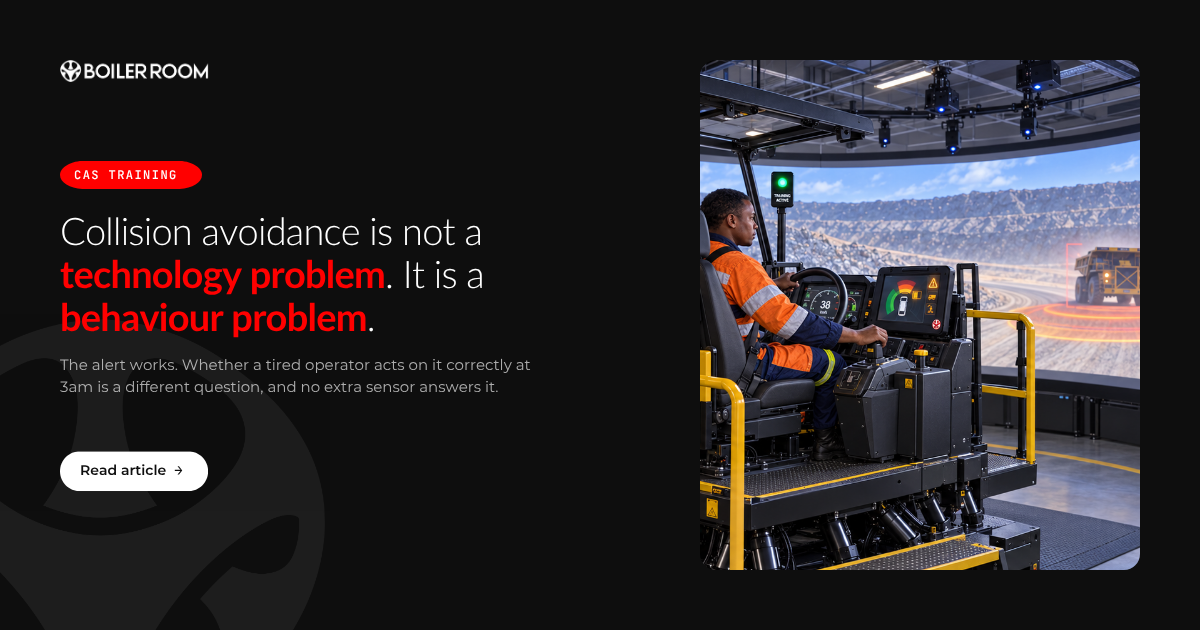
South32 underground VR workplace simulator. Operators rehearse vehicle interaction and alert response where a wrong decision costs nothing and teaches everything.
Why does CAS training failure look like technology failure?
Because the technology is the only part of the system that keeps a log.
When an incident occurs near a functioning CAS, the investigation has an obvious place to start. Alert timings, zone configurations, sensor coverage, firmware versions, all of it recorded and auditable. The human side leaves no equivalent trace. Nobody logs the moment an operator saw an alert, recognised it as the third false positive that shift, and carried on.
So the diagnosis follows the data that exists rather than the data that matters. Operations conclude the system needs tuning, adds a zone, tightens a threshold, and generates more alerts, which makes the underlying problem worse rather than better.
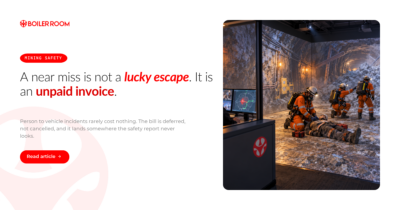
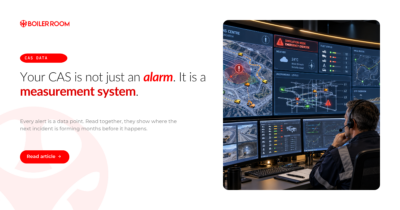
This is compliance theatre at its most expensive. Everything is documented, everything is auditable, and the thing that actually failed was never measured. The same pattern shows up in what collision avoidance data says about operational risk, and it is why a near miss is not a lucky escape but a reading you have not taken yet.
How does simulation-based training change CAS safety outcomes?
By moving the learning to where the decision actually happens.
Classroom CAS training teaches what the system is. Operators learn the zones, the alert types, the intervention thresholds, and can answer questions about all of it. None of that is the skill being tested on shift. The skill is responding correctly to an ambiguous alert, in poor visibility, while under production pressure, at 3am.
Simulation reproduces those conditions. The alert fires when the operator is not expecting it. The zone is entered by something that should not be there. The decision carries an outcome, and the same scenario can be run again until the response stops being a choice and becomes a habit.
It also changes what gets measured. Attendance and completion prove a programme ran. Time to competency, how long before an operator responds correctly without prompting, is the number that tells you whether it worked.
Is training the missing layer in most CAS implementations?
In most operations, yes, and it is usually the cheapest layer left.
A typical CAS rollout budgets generously for hardware, integration and maintenance, and treats training as an induction line item. Operators are shown the system, sign the register, and are considered covered. The behavioural work, the part that determines whether any of the capital converts into fewer incidents, is the smallest number on the page.
Boiler Room Productions builds CAS and PDS training around behavioural response rather than system familiarity. Operators work through scenarios where alerts fire, zones have to be navigated and decisions carry a consequence. What comes out is not knowledge of the system. It is a practised habit around it.
The technology has already done its part. It detects reliably, logs faithfully and costs what it costs. Whether any of that becomes safety depends entirely on what a tired person does in the second after it speaks.
Is your CAS delivering the safety case it was bought for?
We build collision avoidance and proximity detection training that changes what operators do, not just what they know.
Talk to Boiler Room ProductionsFrequently Asked Questions
What is a Collision Avoidance System in mining?
A CAS is a safety control that detects people, vehicles or equipment entering defined danger zones and alerts operators in real time. Higher-specification systems can automatically slow or stop machinery before a collision occurs. Effectiveness depends on both system configuration and consistent trained human response.
Why do CAS systems sometimes fail to prevent incidents?
Usually because the human response around the system was undertrained. The technology may be functioning correctly while operators misunderstand warning zones, ignore repeated alerts or respond inconsistently under operational pressure. Technology and trained behaviour are both required for the system to perform.
What is risk compensation in a mining safety context?
Risk compensation is the tendency to reduce vigilance when you believe a system is protecting you. In mining environments, workers who overestimate CAS capabilities may respond more slowly to alerts, assume the system will intervene first or less active situational awareness. This can make the presence of safety technology counterproductive without proper training.
How is simulation used in CAS and PDS training?
Simulation allows workers to experience warning zones, alerts and vehicle interactions inside realistic operational environments before encountering them live. Rather than learning how a system works theoretically, workers practise how to respond to it under pressure. That distinction produces measurably better safety outcomes.
How long does CAS training take to influence safety performance?
Immediate improvements in confidence and procedural awareness are typical post-training. Measurable changes in near-miss rates and behavioural consistency generally emerge over 30 to 90 days as trained responses replace instinctive reactions. The timeline shortens significantly when simulation is used rather than classroom instruction alone.
Sources and Research
- NIOSH, Mining and Machinery Struck By Injuries
- Minerals Council South Africa, Facts and Figures 2025
- ICMM, Safety Performance and Benchmarking Data 2025
- EMESRT, Vehicle Interaction Controls

About the Author
Jamie Collins
CAS Training and Human Behaviour in Mining Safety, Boiler Room Productions
Jamie leads collision avoidance and proximity detection work at Boiler Room Productions, designing CAS training that addresses the human behaviour behind vehicle interactions rather than the technology alone. His work focuses on the second between an alert firing and an operator deciding what to do about it.
Connect with Jamie on LinkedIn