KEY TAKEAWAYS
- Your CAS is already a measurement system. Every alert it fires is a record of how people, vehicles and equipment actually move around the site, not just a safety control that did its job.
- Lagging indicators tell you what happened. Leading indicators tell you what is coming. Injury and lost time figures are compliance records. Alert clusters, repeated zone breaches and shift patterns are the only part of the sequence still open to change.
- One alert is noise. A pattern is an instruction. A single proximity event says almost nothing. The same zone lighting up week after week is an operational problem with a location attached.
- Collecting the data is not the same as acting on it. Most operations already hold the evidence. What is missing is the routine that turns it into a change on the ground.
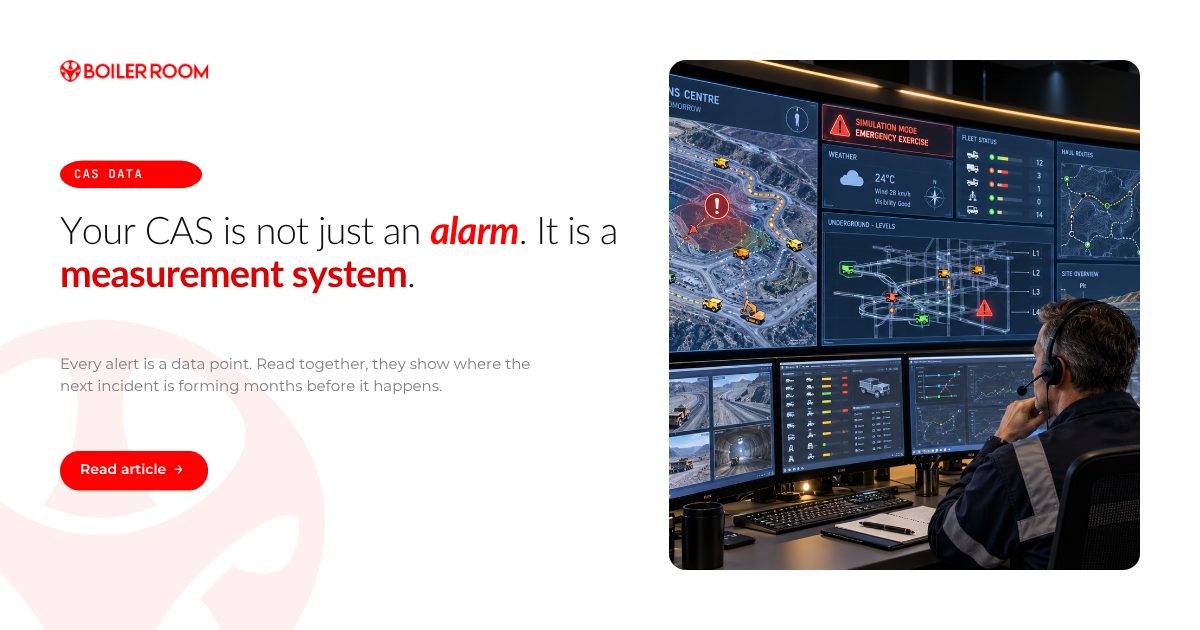
Every collision avoidance system on a mine site is doing two jobs. The first one is the one it was bought for. It watches, it warns, and occasionally it stops a machine before something irreversible happens.
The second job nobody specified, nobody budgeted for, and almost nobody reads. Every alert, zone entry, proximity event and intervention is written down, timestamped and kept. Over a few months that record becomes the most detailed description anyone has of how the operation actually behaves, as opposed to how the procedures say it behaves.
Most of it is never opened. The dashboard shows a number, the number is reported, and the underlying evidence sits in a database nobody has a reason to query.
Which is the expensive part. The dashboard is not the operation. It is a summary of the operation, and summaries are where the useful detail goes to die.
A leading indicator is a measure of the conditions that produce incidents, recorded before an incident happens. A lagging indicator counts the incidents themselves. Injury rates, lost time and vehicle damage are lagging. Proximity alerts, warning zone breaches and clusters of events by shift or location are leading. The distinction matters because only one of the two describes something you can still change.
Why is mining producing more operational data than it can currently use?
Because instrumentation grew faster than the habit of reading it.
A modern mine records fleet performance, fuel burn, tyre wear, fatigue events, production rates, ventilation, ground movement and proximity interactions, continuously and automatically. Almost none of that existed in usable form fifteen years ago. The collection problem is solved.
The interpretation problem is not. Data becomes useful at the point somebody has both the time to look and the authority to change something as a result, and in most operations those two things sit with different people. So the reporting layer thrives and the analysis layer does not.
W. Edwards Deming is routinely quoted as saying you cannot manage what you cannot measure. He said close to the opposite. His actual argument was that the most important figures in any organisation are unknown and unknowable, and that running a business on visible numbers alone is a mistake. Mining has built beautiful dashboards on exactly the assumption he warned against.
What is the difference between leading and lagging safety indicators?
Lagging indicators count outcomes. Leading indicators describe the conditions that produce them.
Lagging measures are precise, auditable and comfortable. They are also, by definition, a record of harm that has already occurred. The Minerals Council recorded 41 fatalities in South African mining in 2025, the lowest annual figure in three decades, with serious injuries down 12% to 1,693. ICMM’s 2025 data records 11 fatalities across member operations in Africa, the joint highest of any region worldwide. Real numbers, honestly reported, and every one of them arrives too late to act on.
NIOSH reports that more than 40% of the most serious injuries in mining, meaning fatalities and permanent disabilities, involve accidents classified as struck by or caught in machinery and powered haulage equipment. That is the category CAS exists to address, and it is the category where leading indicators are most abundant and least used.
The cost of getting this wrong is not abstract. The National Safety Council puts the total cost of work injuries in the United States at 181.4 billion dollars in 2024, roughly 1,120 dollars per worker and 102 million lost working days. Those totals count outcomes. The conditions that produced them were visible first.
What does CAS alert data actually reveal about an operation?
Where people and machines actually meet, as opposed to where the traffic plan says they should.
Read individually, alerts are noise. Read collectively, they become a map. Certain intersections generate warnings consistently. Particular zones show higher pedestrian exposure on particular shifts. Clusters appear during shift change, during peak haulage, during the last hour before a break.
None of that is in the traffic management plan, because the plan describes intention and the alert log describes behaviour. Where the two disagree, the alert log is right.
This is the same argument we make about individual events in the hidden cost of near misses. One near miss at an intersection is an incident. Twenty at the same intersection over three months is a design problem that now has an address.
Simulation and immersive training built by Boiler Room Productions, where the behaviour behind the alert data is rehearsed rather than reported.
Why does data alone not improve safety outcomes?
Because a finding only becomes a control when somebody changes what people do.
An operation identifies a high alert intersection. The finding is real, the evidence is solid, and then it goes into a report. Nothing about the intersection changes. Nothing about how operators approach it changes. The following quarter it appears in the data again, and the conclusion is that the analysis was correct.
Analysis without a change mechanism is expensive observation. The mechanism is almost always one of two things. Redesign the environment, which is slow and capital intensive, or change the behaviour, which is faster and cheaper and requires training that goes beyond system familiarity.
This is why CAS rollouts underdeliver so consistently. The gap is not detection and it is not analysis. It is the step after, which we set out in why collision avoidance systems fail without human behaviour change.
What does the next generation of CAS capability look like?
Less alerting, more pattern recognition, and a training loop attached to both.
The direction of travel is away from raw alert volume and towards interpretation. Systems that distinguish a routine interaction from a developing risk. Reporting that surfaces a location and a shift rather than a count. Integration with fatigue and production data so that a cluster can be explained rather than simply recorded.
All of which raises the requirement on the person receiving it. A better system produces a more specific instruction, and a more specific instruction is worth nothing to an operator who has been trained on what the system is rather than what to do when it speaks.
Boiler Room Productions builds CAS and PDS training around that response. Operators work through scenarios where alerts fire, zones have to be navigated and decisions carry a consequence. Supervisors learn to read the trend data rather than the alert count. The measure that matters is time to competency, not attendance.
The data is already there. It has been there since the day the system was commissioned. The only question is whether anybody is reading it and whether anything changes when they do.
Is your CAS data telling you something nobody is reading?
We build collision avoidance and proximity detection training that turns alert data into changed behaviour on the ground.
Talk to Boiler Room ProductionsFrequently Asked Questions
What data does a Collision Avoidance System generate?
CAS systems record every alert activation, proximity event, warning zone entry, vehicle interaction and automated intervention. Over time, this accumulates into a detailed operational dataset showing where, when and how risk events are occurring across a site, far more granular than incident reports or safety walks can produce.
What is the difference between reactive and predictive mining safety?
Reactive safety responds to incidents after they occur. Predictive safety uses leading indicator data, alert patterns, near-miss frequencies, behavioural trends, to intervene before incidents develop. CAS systems are one of the most accessible sources of predictive safety data available to modern mining operations.
How should mining safety leaders use CAS alert data?
Look for patterns, not individual events. High-frequency alert zones may need traffic redesign, not just driver retraining. Shift-based clusters may point to fatigue or production pressure. Vehicle-type specific alerts may reveal equipment visibility limitations. The data becomes strategic when it informs decisions about site design, training and operational procedure, not just when it documents that an alert occurred.
Why do some mines not get value from their CAS systems?
Usually because the system is treated as a control rather than an intelligence source. Alerts are logged and closed rather than analysed for patterns. Supervisors are not trained to interpret trend data. Safety leadership reviews incident reports rather than leading indicators. The technology is working, the analytical capability around it is not.
Does CAS training improve how workers respond to system alerts?
Yes, substantially. Workers who have rehearsed alert responses in realistic simulation environments respond faster, more consistently and with greater confidence than those trained through classroom instruction alone. Practised response under simulated pressure is the most reliable way to build the behavioural competence that makes CAS technology perform as intended.
Sources and Research
- NIOSH, Mining and Machinery Struck By Injuries
- Minerals Council South Africa, Facts and Figures 2025
- ICMM, Safety Performance and Benchmarking Data 2025
- National Safety Council, Injury Facts, Work Injury Costs 2024

About the Author
Jamie Collins
Collision Avoidance Systems Data and Mining Safety Training, Boiler Room Productions
Jamie leads collision avoidance and proximity detection work at Boiler Room Productions, helping mining operations turn collision avoidance data into training that changes behaviour rather than reports that describe it. His work focuses on the step between a finding and a control.
Connect with Jamie on LinkedIn