KEY TAKEAWAYS
- A near miss is not a free event. Nothing happened this time. The conditions that produced it are still in place tomorrow, and the bill has been deferred rather than cancelled.
- The direct cost is near zero. The indirect cost is not. Stoppages, investigations, diverted supervision and regulatory involvement consume real resources for an event that officially cost nothing.
- Collision avoidance systems generate data, not just alerts. Twenty proximity events at one intersection is not twenty incidents. It is a traffic design problem with a location.
- Technology detects. Only training decides. A system can flag a hazard. It cannot make a tired operator respond correctly at 3am.
When a serious vehicle incident happens on a mine site, everyone notices. Investigations begin. Operations stop. Equipment is damaged. Regulators arrive. In the worst cases lives are permanently altered.
Near misses receive none of that attention. An operator and a pedestrian come within metres of each other. The situation resolves. No injury, no damage, no interruption worth reporting. Within the hour it has been filed as a success. Nothing happened.
That framing is one of the most expensive misunderstandings in mining safety. A near miss is not a lucky escape. It is an unpaid invoice. The cost was incurred. It simply has not been presented yet.
The question worth asking is not why nothing happened. It is how many more times you can rely on that being true.
DEFINITION
A near miss is an unplanned event that caused no injury or damage but had the potential to do so under slightly different conditions. In mining, near misses involving vehicles and pedestrians are leading indicators of serious incident risk. They are not proof that the system is working. They are evidence that it is under pressure.
Why do mining organisations systematically undervalue near miss data?
Because mining measures outcomes well and precursors badly.
Lost time injuries, recordable incidents and compliance rates are tracked with real precision. The conditions that produce those incidents receive far less analytical attention, despite being the only part of the sequence that can still be changed.
The scale is not abstract. The Minerals Council South Africa reported 41 mining fatalities in 2025, the lowest figure in three decades, alongside 1,693 serious injuries, down 12 percent on the previous year. Genuine progress. But ICMM safety data for the same year records 11 fatalities across member operations in Africa, joint highest of any region worldwide. The gap between improving and safe is still being closed by margins.
Every near miss involving a haul truck, loader, light vehicle or pedestrian is operational data, not operational luck. The question is never whether an incident occurred. It is what the near miss reveals about the conditions that produced it.
What do vehicle near misses actually cost?
Almost nothing directly, and a great deal indirectly.
No injury, no compensation claim, no repair bill. This is exactly why the financial case for investigating near misses is so rarely made convincingly. The money leaves quietly.
The National Safety Council puts the total cost of work injuries at 181.4 billion dollars in 2024, roughly 1,120 dollars per worker and 102 million lost working days. Those figures count incidents that were recorded. The near misses that preceded them appear nowhere in the total.
On site the pattern is familiar. A vehicle interaction triggers a temporary stoppage while the area is assessed. Production schedules shift. Supervisors and safety personnel leave their actual work to manage it. Where contractors, insurers or regulators become involved, administrative cost accumulates fast, and the serious cases end up needing full accident reconstruction before anyone can agree what actually happened. Significant organisational resource is consumed handling an event that officially cost nothing.
And the conditions remain. The intersection that generated the close call has the same traffic design tomorrow. The shift pattern that dulled the operator awareness runs again. The alert that was ignored once will be ignored again.
Near misses left unexamined are not resolved risks. They are deferred ones.
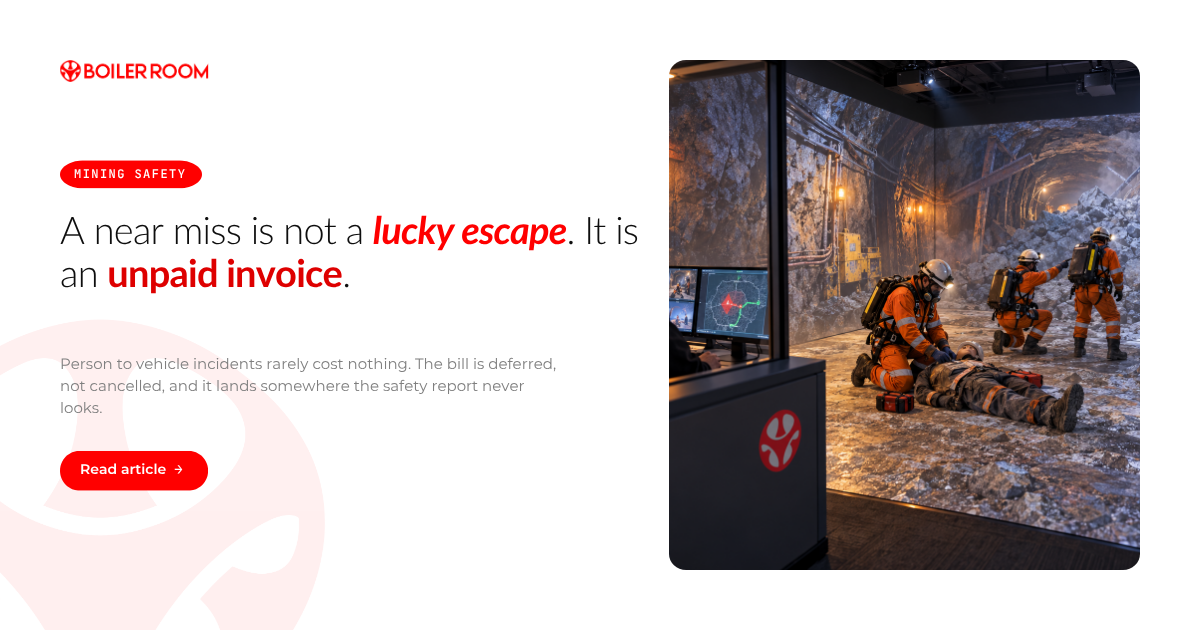
South32 underground VR workplace simulator. Operators rehearse vehicle interaction and emergency response where a wrong decision costs nothing but teaches everything.
How does CAS data turn near misses into operational intelligence?
By turning one off events into patterns with a location and a time.
The Earth Moving Equipment Safety Round Table has put substantial resource into vehicle interaction controls across global mining, recognising that person to vehicle and vehicle to vehicle interactions remain among the most persistent sources of serious risk.
Modern collision avoidance systems produce something more useful than alarms. They produce a record. Every warning, proximity event, zone entry and intervention is logged. Over weeks those records become a picture of how people, vehicles and equipment actually move around a site, at a level of detail no incident report or safety walk will ever match.
Certain intersections generate alerts consistently. Particular zones show higher pedestrian exposure on particular shifts. Clusters of proximity events during peak production reveal exactly how operational pressure changes behaviour.
A single near miss at an intersection is an incident. Twenty near misses at the same intersection over three months is a traffic design problem, and it now has an address.
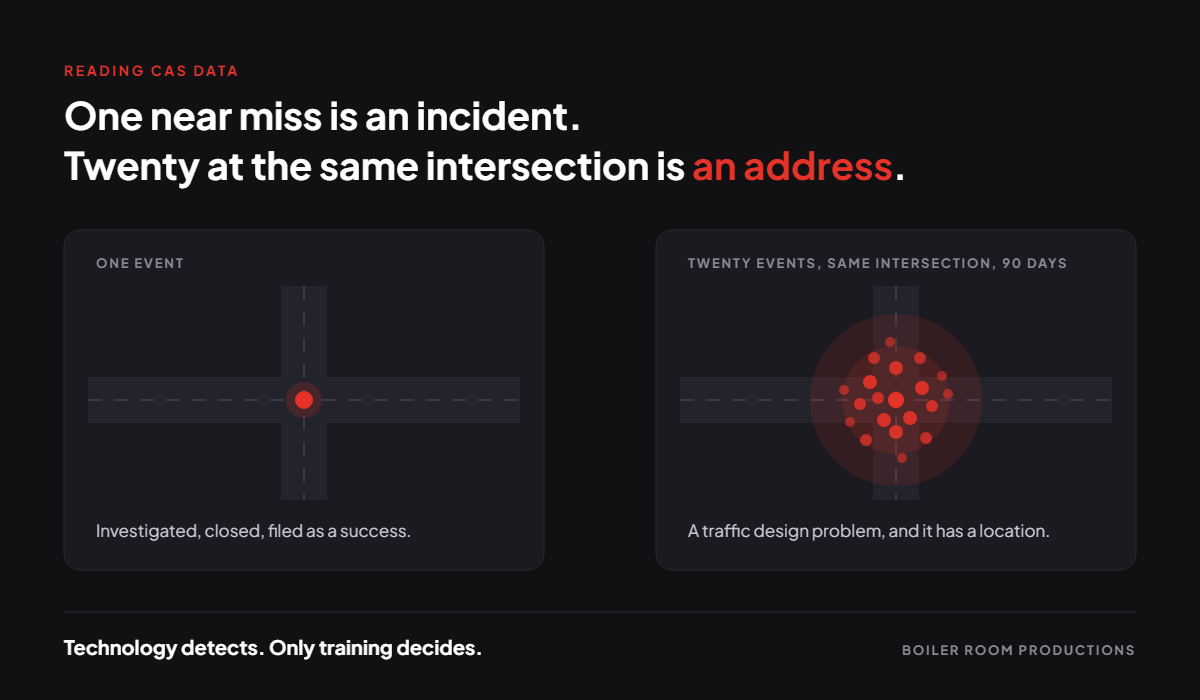
That shift, from event to pattern, is where the operational value sits. We look at it in more depth in what collision avoidance data says about operational risk.
Why does training still matter when the technology works?
Because a system can detect a hazard. It cannot decide what to do about one.
An alert only works if the person receiving it understands what it means and responds correctly, under pressure, at the end of a shift. That gap is not a technology problem and no amount of additional sensors will close it. It is the same reason collision avoidance systems fail without human behaviour change.
Workers need to know how the system behaves, what each alert indicates, how warning zones are configured and what action is required. Supervisors need to read trend data. Safety leaders need to turn that data into changes on the ground.
Boiler Room Productions builds CAS and PDS training around behavioural response rather than system familiarity. Operators work through scenarios where alerts fire, zones have to be navigated and decisions carry an outcome. What comes out is not knowledge of the system. It is a practised habit around it.
The most valuable incident in mining is the one that never happens. Getting there means treating every near miss as a question rather than a conclusion.
Is your CAS data telling you something nobody is reading?
We build collision avoidance and proximity detection training that changes what operators do, not just what they know.
Frequently Asked Questions
What is a near miss in mining safety?
A near miss is an unplanned event that caused no injury or damage but had the potential to under slightly different conditions. In mining, near misses involving heavy vehicles and pedestrians are treated as leading indicators of serious incident risk, not as proof that safety controls are working.
Why are mining near misses expensive when no injury occurs?
Because the indirect costs are far larger than the direct ones. Stoppages, investigations, diverted supervisory time, regulatory involvement and the unchanged conditions that will produce the next event all carry real cost. Most operations have never calculated that total honestly.
How do collision avoidance systems reduce near miss incidents?
CAS detects people, vehicles and hazards entering danger zones and alerts the operator before contact. Over time the accumulated data reveals behavioural patterns, which lets an operation redesign traffic flow, retrain operators and reconfigure zones before a risk escalates.
What should mining companies do with near miss data?
Analyse it for patterns rather than individual events. One near miss at an intersection is an incident. Twenty at the same intersection over three months is a design problem. CAS makes that analysis possible, and most operations are not yet using the data that way.
Is CAS training required for proximity detection systems in South Africa?
Section 10(2) of the Mine Health and Safety Act requires employers to ensure workers are competent in the specific conditions, equipment and procedures of that mine. As proximity detection becomes standard across surface operations, CAS and PDS training is increasingly treated as a compliance requirement rather than good practice.
How many people die in South African mining each year?
The Minerals Council South Africa recorded 41 fatalities across the industry in 2025, the lowest annual figure in three decades, with serious injuries down 12 percent to 1,693. ICMM data for the same year shows 11 fatalities across member operations in Africa, the joint highest of any global region.
Sources and Research
- Minerals Council South Africa, Facts and Figures Pocketbook 2025
- ICMM, Safety Performance and Benchmarking Data 2025
- National Safety Council, Injury Facts, Work Injury Costs 2024
- EMESRT, Vehicle Interaction Controls

About the Author
Jamie Collins
Mining Safety and Collision Avoidance, Boiler Room Productions
Jamie leads mining safety and collision avoidance work at Boiler Room Productions, designing collision avoidance system training that addresses the human behaviour behind vehicle interactions rather than the technology alone.