KEY TAKEAWAYS
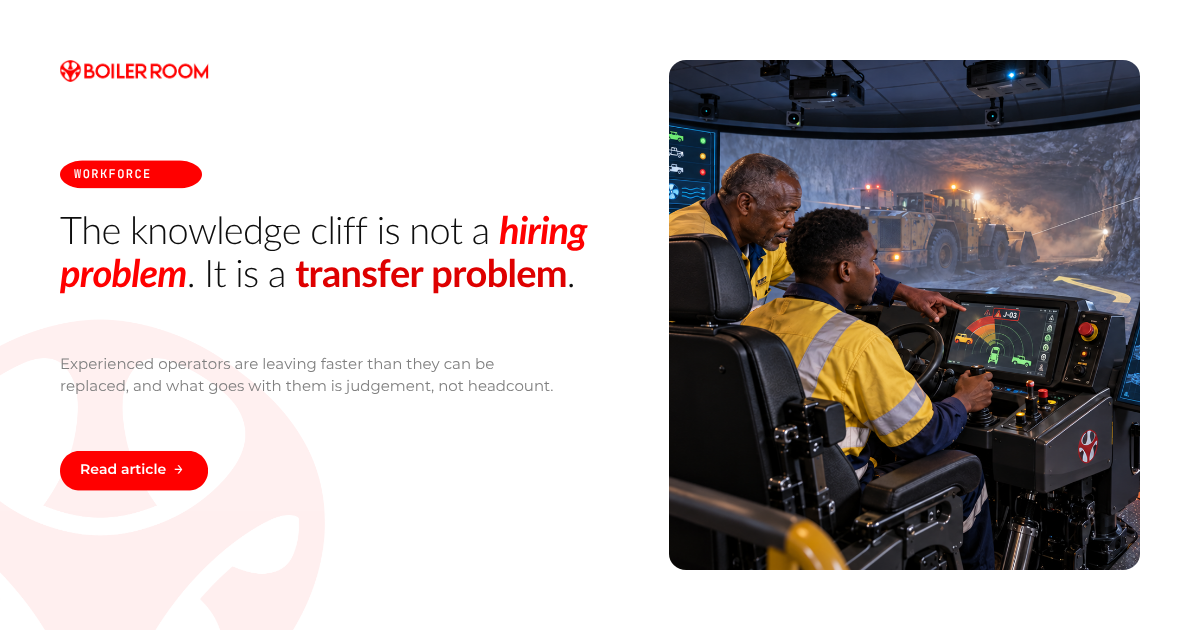
- The knowledge cliff is not a recruitment problem. Experienced operators are leaving faster than they can be replaced, and what leaves with them is judgement, not headcount.
- More access to information has made training harder, not easier. This workforce can find any procedure in seconds. What it cannot do is rehearse the decision the procedure describes.
- The technology got more sophisticated, so the training had to. CAS, PDS, autonomous equipment and fatigue monitoring all assume an operator who understands what the system is telling them and why.
- Time to competency is the number that matters now. Attendance and completion rates prove a programme ran. Only time to competency shows whether it worked.
For most of mining’s history, safety knowledge moved the way anything valuable moves. Person to person. A new operator stood alongside someone who had already made the mistake, watched what they did about it, and slowly built the instinct that keeps people alive on a haul road.
That transfer is breaking, and not because anyone stopped caring about it. The people holding the knowledge are leaving faster than the industry can hand it over.
The obvious response is to write more of it down, and mining has done that thoroughly. Procedures, inductions, toolbox talks, LMS modules, all of it searchable in seconds by a workforce more comfortable with a screen than any generation before it.
Which is exactly where the problem sits. This is a workforce that can retrieve almost anything and has rehearsed almost nothing. Access to information is not access to judgement, and safety runs on the second one.
Knowledge transfer in mining is the movement of operational judgement, the unwritten reasoning experienced workers apply to real conditions, from one generation of workers to the next. It is not the same as information transfer. A procedure can be written down and distributed. The judgement about when it applies, and what to do when conditions do not match it, has historically only moved by working next to someone who already had it.
What is the scale of the workforce transition in mining?
Large enough that it cannot be solved by hiring.
The Society for Mining, Metallurgy and Exploration projects that more than 221,000 mining workers in the United States, over half the current workforce, will have retired and been replaced by 2029, and that the industry will need to fill 11,000 to 13,000 roles a year for two decades simply to keep pace. In South Africa the Minerals Council reports the industry employs roughly 450,000 people directly, with a further 250,000 in contractor roles.
Those are large numbers, and they are the least interesting part of the problem. Headcount can be replaced inside a quarter. What leaves with a retiring operator is the accumulated reasoning of someone who has met conditions that appear in no procedure, and who learned what to do about them the slow way.
That is the knowledge cliff. Not a shortage of people. A shortage of the years behind them.
Why has information access made training harder, not easier?
Because retrieval feels like competence, and it is not.
The World Economic Forum’s Future of Jobs Report 2025 found that employers expect 39% of the skills workers need to change by 2030, that 59% of the global workforce will require training in that window, and, most usefully for anyone running a training function, that 11 in every 100 workers will need training they will not be able to access. The gap is not awareness. It is delivery.
There is a quieter effect underneath it. Making information trivially easy to reach lowers the felt need to internalise it. If the answer is always three seconds away, the brain treats holding it as wasted effort, and it is right to, for almost everything except the situations where three seconds is the whole margin.
Sir Ken Robinson spent a career arguing that education systems were built to reward recall and compliance, and that capability is a different output requiring different conditions. Mining inherited the same assumption. A completed module proves attendance. It does not prove that anyone can act.
Apply the 3am test. A procedure the operator has read, at the end of a night shift, in poor visibility, with a vehicle where it should not be. Reading is not the thing being tested. Rehearsal is.
TARP 360. Trigger action response rehearsed in the environment it belongs to, where a wrong decision costs nothing and teaches everything.
How are CAS and PDS technologies changing workforce training requirements?
They raise the floor on what a new operator has to understand before their first shift.
South African mining has made real ground. The Minerals Council recorded 41 fatalities in 2025, the lowest annual figure in three decades, with serious injuries down 12% to 1,693. ICMM’s 2025 safety data records 11 fatalities across member operations in Africa, still the joint highest of any region worldwide.
Almost every one of those gains rests on a control that assumes a trained human response. Collision avoidance systems, proximity detection, fatigue monitoring and autonomous equipment all detect and alert. None of them decide. An operator who does not understand how warning zones are configured, when intervention activates, or what a particular alert is actually reporting, is working alongside a system rather than with it.
This is the same failure mode we set out in why collision avoidance systems fail without human behaviour change, and the reason the alert data itself is worth reading, which we cover in what collision avoidance data says about operational risk.
Why is simulation-based training gaining ground in mining safety?
Because it is the only method that lets someone be wrong safely, and then be wrong again.
Mentorship worked because it produced repetition under real conditions with someone experienced watching. Take away the experienced person and the repetition goes with them. Simulation puts both back. The conditions are reproduced, the decision carries a consequence, and the same scenario can be run until the response stops being a choice and starts being a habit.
It also makes the right thing measurable. Attendance and completion tell you a programme ran. Time to competency tells you how long it takes a new operator to respond correctly without prompting, and that is the number an operations manager can actually use.
Boiler Room Productions builds mining safety training around that outcome. Operators work through vehicle interactions, alert responses and emergency scenarios in environments that match their site, and the measure of success is what changes on the ground rather than what was covered in the room.
The last generation learned safety by standing next to someone who had already made the mistake. That person is retiring. The question is whether the mistake retires with them, or gets rehearsed by everyone who comes next.
Is your safety training keeping pace with who is actually doing the work?
We build simulation and CAS training that transfers judgement, not just procedure.
Talk to Boiler Room ProductionsFrequently Asked Questions
Why do younger mining workers need different safety training?
Because their learning expectations are shaped by interactive digital environments, not passive content delivery. A generation raised on responsive, feedback-driven technology will not engage effectively with static compliance training. More importantly, the technologies they are being trained on, CAS, PDS, autonomous systems, require practised response, not just procedural awareness.
What makes CAS and PDS training different from standard safety induction?
Standard induction covers what systems exist and what regulations require. CAS and PDS training needs to go further: how alerts behave in different operational conditions, how warning zones are configured, when intervention systems activate and how to respond correctly under pressure. That level of competence requires simulation, not just instruction.
How does simulation training address the knowledge transfer problem in mining?
By allowing experienced operational behaviour to be captured in realistic scenarios that new workers can rehearse repeatedly. Rather than relying on mentorship from operators who are retiring, simulation creates environments where operational judgement can be practised before it is needed. It compresses years of exposure into structured, repeatable learning.
Is immersive CAS training suitable for surface mining environments?
Yes. Surface mining environments, with their haul roads, traffic intersections, mixed vehicle and pedestrian zones, are precisely the conditions that benefit most from simulation. Workers can practise navigating high-risk interactions, warning zones and alert responses in environments that reflect their actual operational reality.
What does best-practice CAS training look like in 2026?
It combines procedural foundation with simulation-based application. Workers learn system theory, then practise system response in realistic scenarios. Training is assessed through demonstrated behaviour under simulated pressure, not just knowledge tests. Refresher scenarios are built into the training cadence. And near-miss data from live operations feeds back into training design.
Sources and Research
- Minerals Council South Africa, Facts and Figures 2025
- ICMM, Safety Performance and Benchmarking Data 2025
- World Economic Forum, Future of Jobs Report 2025
- Society for Mining, Metallurgy and Exploration, Workforce Trends in the US Mining Industry

About the Author
Jamie Collins
Mining Safety Training and Knowledge Transfer, Boiler Room Productions
Jamie leads mining safety and collision avoidance at Boiler Room Productions, designing mining safety training and simulation programmes for surface and underground operations. His work focuses on the gap between what a procedure says and what an operator actually does when conditions do not match it.
Connect with Jamie on LinkedIn